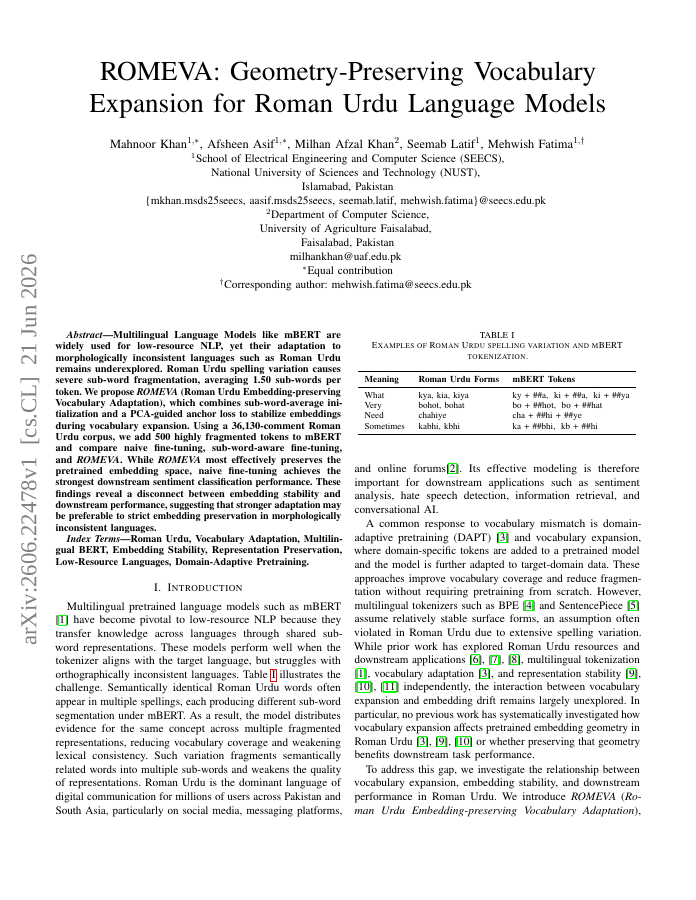
Multilingual Language Models like mBERT are widely used for low-resource NLP, yet their adaptation to morphologically inconsistent languages such as Roman Urdu remains underexplored. Roman Urdu spelling variation causes severe sub-word fragmentation, averaging 1.50 sub-words per token. We propose ROMEVA (Roman Urdu Embedding-preserving Vocabulary Adaptation), which combines sub-word-average initialization and a PCA-guided anchor loss to stabilize embeddings during vocabulary expansion. Using a 36,130-comment Roman Urdu corpus, we add 500 highly fragmented tokens to mBERT and compare naive fine-tuning, sub-word-aware fine-tuning, and ROMEVA. While ROMEVA most effectively preserves the pretrained embedding space, naive fine-tuning achieves the strongest downstream sentiment classification performance. These findings reveal a disconnect between embedding stability and downstream performance, suggesting that stronger adaptation may be preferable to strict embedding preservation in morphologically inconsistent languages.
ROMEVA: Geometry-Preserving Vocabulary Expansion for Roman Urdu Language Models
Multilingual Language Models like mBERT are widely used for low-resource NLP, yet their adaptation to morphologically inconsistent languages such as Roman Urdu remains underexplored.
- Preview
- Year
- 2026
- Hosting
- Excerpt onlyCC-BY-NC-SA-4.0
Cite
Notes
Only stored in your browser.
Attribution
- Abstract & full text
- arxiv.org/abs/2606.22478CC-BY-NC-SA-4.0
- TL;DR
- Semantic Scholar