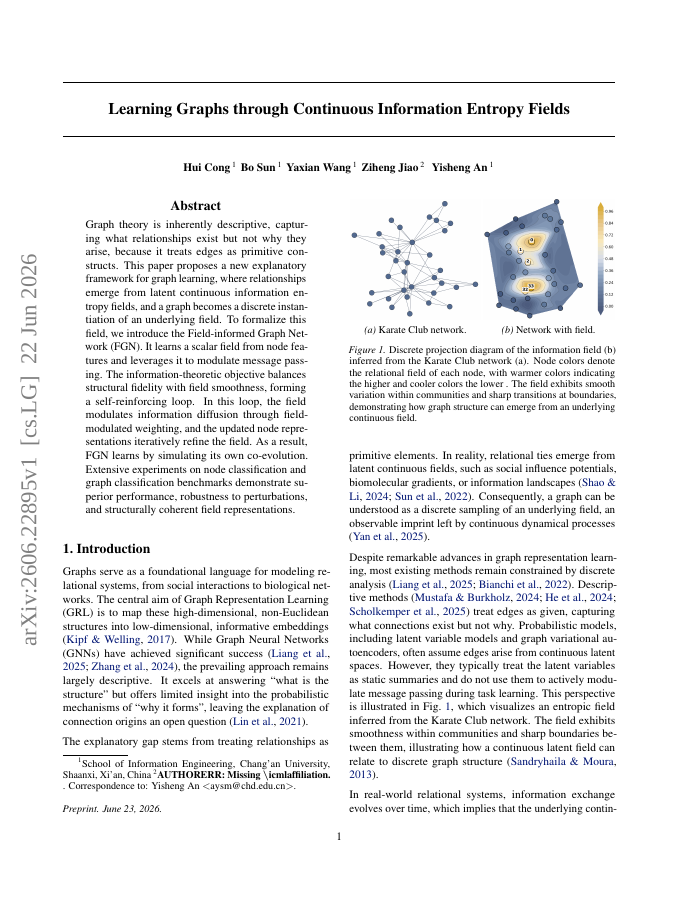
Graph theory is inherently descriptive, capturing what relationships exist but not why they arise, because it treats edges as primitive constructs. This paper proposes a new explanatory framework for graph learning, where relationships emerge from latent continuous information entropy fields, and a graph becomes a discrete instantiation of an underlying field. To formalize this field, we introduce the Field-informed Graph Network (FGN). It learns a scalar field from node features and leverages it to modulate message passing. The information-theoretic objective balances structural fidelity with field smoothness, forming a self-reinforcing loop. In this loop, the field modulates information diffusion through field-modulated weighting, and the updated node representations iteratively refine the field. As a result, FGN learns by simulating its own co-evolution. Extensive experiments on node classification and graph classification benchmarks demonstrate superior performance, robustness to perturbations, and structurally coherent field representations.
Learning Graphs through Continuous Information Entropy Fields
Graph theory is inherently descriptive, capturing what relationships exist but not why they arise, because it treats edges as primitive constructs. This paper proposes a new explanatory framework for graph learning, where relationships emerge from latent continuous information…
- Preview
- Year
- 2026
- Hosting
- Abstract onlyARXIV-DEFAULT
Cite
Notes
Only stored in your browser.
Attribution
- Abstract & full text
- arxiv.org/abs/2606.22895ARXIV-DEFAULT
- TL;DR
- Semantic Scholar