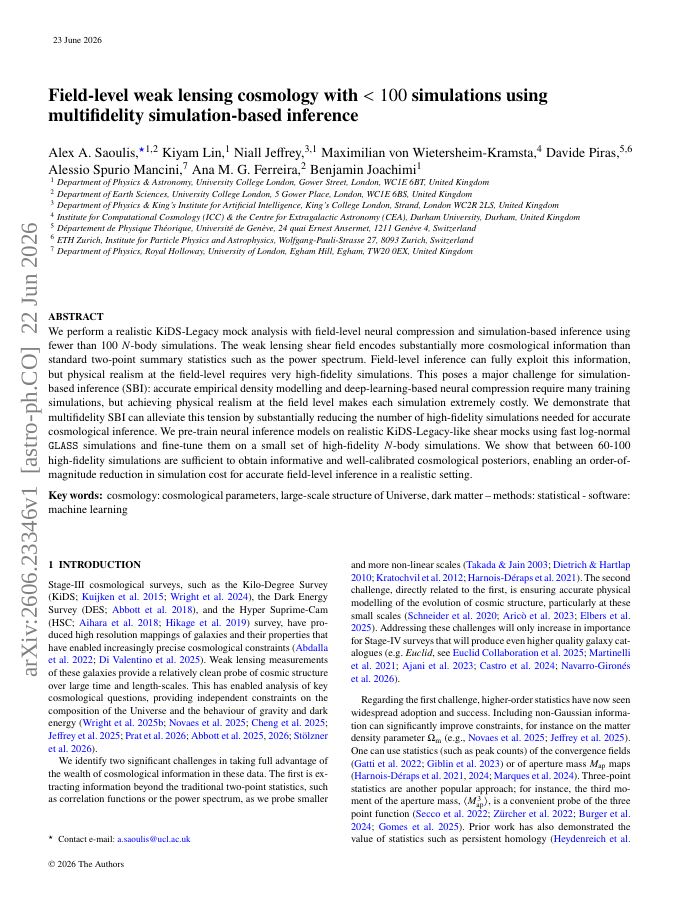
We perform a realistic KiDS-Legacy mock analysis with field-level neural compression and simulation-based inference using fewer than 100 N-body simulations. The weak lensing shear field encodes substantially more cosmological information than standard two-point summary statistics such as the power spectrum. Field-level inference can fully exploit this information, but physical realism at the field-level requires very high-fidelity simulations. This poses a major challenge for simulation-based inference (SBI): accurate empirical density modelling and deep-learning-based neural compression require many training simulations, but achieving physical realism at the field level makes each simulation extremely costly. We demonstrate that multifidelity SBI can alleviate this tension by substantially reducing the number of high-fidelity simulations needed for accurate cosmological inference. We pre-train neural inference models on realistic KiDS-Legacy-like shear mocks using fast log-normal GLASS simulations and fine-tune them on a small set of high-fidelity N-body simulations. We show that between 60-100 high-fidelity simulations are sufficient to obtain informative and well-calibrated cosmological posteriors, enabling an order-of-magnitude reduction in simulation cost for accurate field-level inference in a realistic setting.
Field-level weak lensing cosmology with $<100$ simulations using multifidelity simulation-based inference
We perform a realistic KiDS-Legacy mock analysis with field-level neural compression and simulation-based inference using fewer than 100 $N$-body simulations. The weak lensing shear field encodes substantially more cosmological information than standard two-point summary…
- Preview
- Year
- 2026
- Hosting
- Full text hostedCC-BY-4.0
Cite
Notes
Only stored in your browser.
Attribution
- Abstract & full text
- arxiv.org/abs/2606.23346CC-BY-4.0
- TL;DR
- Semantic Scholar