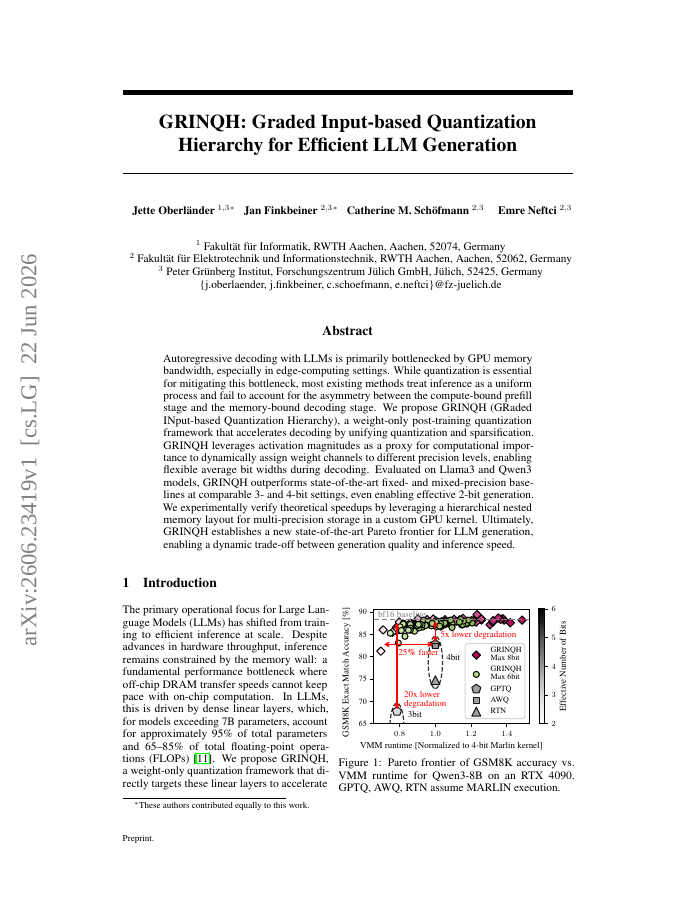
Autoregressive decoding with LLMs is primarily bottlenecked by GPU memory bandwidth, especially in edge-computing settings. While quantization is essential for mitigating this bottleneck, most existing methods treat inference as a uniform process and fail to account for the asymmetry between the compute-bound prefill stage and the memory-bound decoding stage. We propose GRINQH (GRaded INput-based Quantization Hierarchy), a weight-only post-training quantization framework that accelerates decoding by unifying quantization and sparsification. GRINQH leverages activation magnitudes as a proxy for computational importance to dynamically assign weight channels to different precision levels, enabling flexible average bit widths during decoding. Evaluated on Llama3 and Qwen3 models, GRINQH outperforms state-of-the-art fixed- and mixed-precision baselines at comparable 3- and 4-bit settings, even enabling effective 2-bit generation. We experimentally verify theoretical speedups by leveraging a hierarchical nested memory layout for multi-precision storage in a custom GPU kernel. Ultimately, GRINQH establishes a new state-of-the-art Pareto frontier for LLM generation, enabling a dynamic trade-off between generation quality and inference speed.
GRINQH: Graded Input-based Quantization Hierarchy for Efficient LLM Generation
Autoregressive decoding with LLMs is primarily bottlenecked by GPU memory bandwidth, especially in edge-computing settings. While quantization is essential for mitigating this bottleneck, most existing methods treat inference as a uniform process and fail to account for the…
- Preview
- Year
- 2026
- Hosting
- Abstract onlyARXIV-DEFAULT
Cite
Notes
Only stored in your browser.
Attribution
- Abstract & full text
- arxiv.org/abs/2606.23419ARXIV-DEFAULT
- TL;DR
- Semantic Scholar