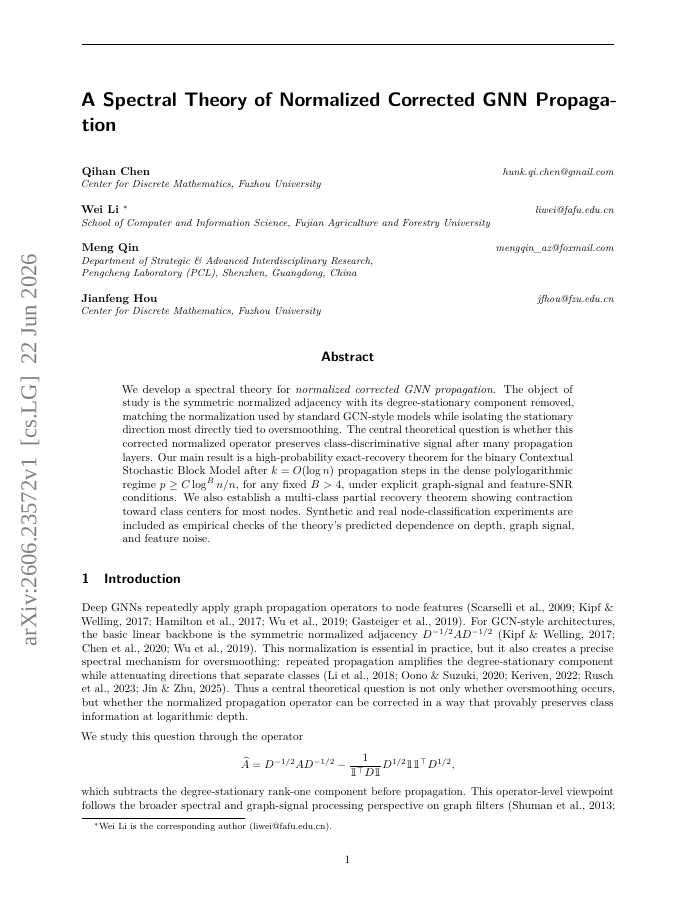
We develop a spectral theory for normalized corrected GNN propagation. The object of study is the symmetric normalized adjacency with its degree-stationary component removed, matching the normalization used by standard GCN-style models while isolating the stationary direction most directly tied to oversmoothing. The central theoretical question is whether this corrected normalized operator preserves class-discriminative signal after many propagation layers. Our main result is a high-probability exact-recovery theorem for the binary Contextual Stochastic Block Model after k=O(\log n) propagation steps in the dense polylogarithmic regime p\ge C\log^B n/n, for any fixed B>4, under explicit graph-signal and feature-SNR conditions. We also establish a multi-class partial recovery theorem showing contraction toward class centers for most nodes. Synthetic and real node-classification experiments are included as empirical checks of the theory's predicted dependence on depth, graph signal, and feature noise.
A Spectral Theory of Normalized Corrected GNN Propagation
We develop a spectral theory for \emph{normalized corrected GNN propagation}. The object of study is the symmetric normalized adjacency with its degree-stationary component removed, matching the normalization used by standard GCN-style models while isolating the stationary…
- Preview
- Year
- 2026
- Hosting
- Abstract onlyARXIV-DEFAULT
Cite
Notes
Only stored in your browser.
Attribution
- Abstract & full text
- arxiv.org/abs/2606.23572ARXIV-DEFAULT
- TL;DR
- Semantic Scholar