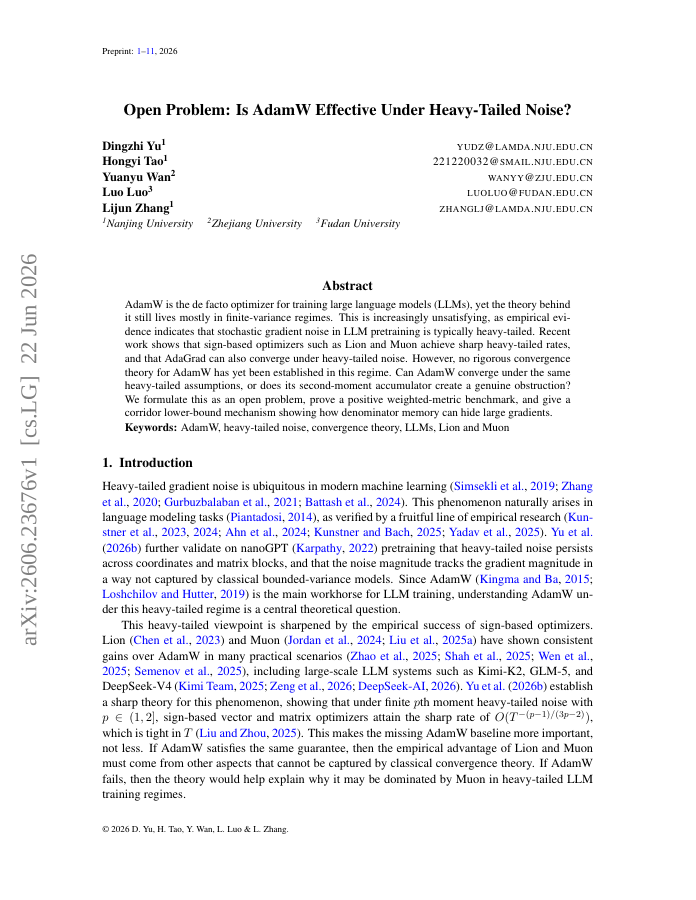
AdamW is the de facto optimizer for training large language models (LLMs), yet the theory behind it still lives mostly in finite-variance regimes. This is increasingly unsatisfying, as empirical evidence indicates that stochastic gradient noise in LLM pretraining is typically heavy-tailed. Recent work shows that sign-based optimizers such as Lion and Muon achieve sharp heavy-tailed rates, and that AdaGrad can also converge under heavy-tailed noise. However, no rigorous convergence theory for AdamW has yet been established in this regime. Can AdamW converge under the same heavy-tailed assumptions, or does its second-moment accumulator create a genuine obstruction? We formulate this as an open problem, prove a positive weighted-metric benchmark, and give a corridor lower-bound mechanism showing how denominator memory can hide large gradients.
Open Problem: Is AdamW Effective Under Heavy-Tailed Noise?
AdamW is the de facto optimizer for training large language models (LLMs), yet the theory behind it still lives mostly in finite-variance regimes. This is increasingly unsatisfying, as empirical evidence indicates that stochastic gradient noise in LLM pretraining is typically…
- Preview
- Year
- 2026
- Hosting
- Abstract onlyARXIV-DEFAULT
Cite
Notes
Only stored in your browser.
Attribution
- Abstract & full text
- arxiv.org/abs/2606.23676ARXIV-DEFAULT
- TL;DR
- Semantic Scholar