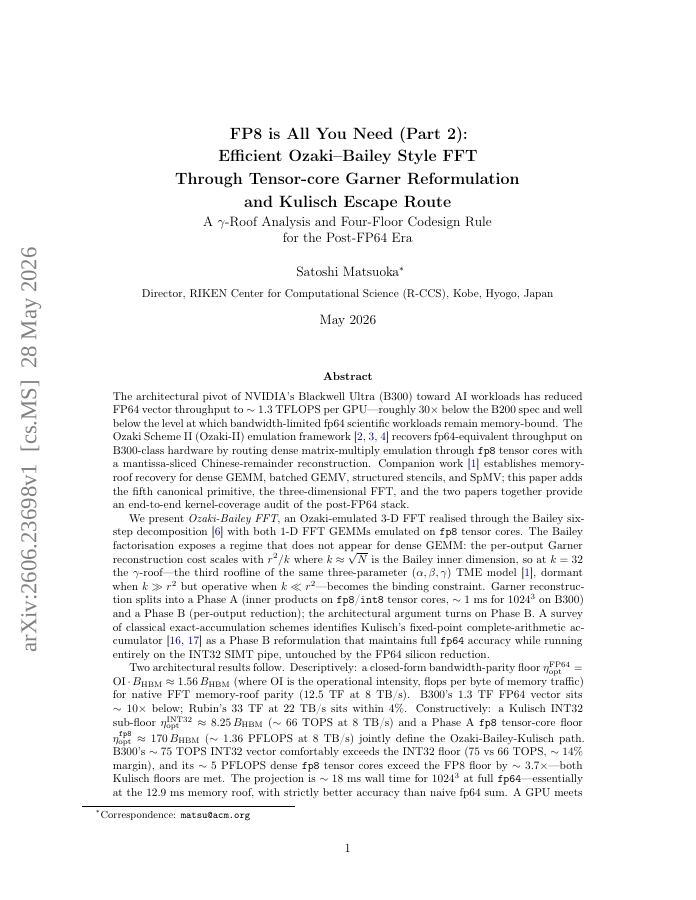
NVIDIA's Blackwell Ultra (B300) cuts FP64 vector throughput to 1.3 TFLOPS per GPU, roughly 30x below B200 and well below the level at which bandwidth-limited FP64 workloads stay memory-bound. The Ozaki Scheme II framework recovers FP64-equivalent throughput by routing dense matrix multiply through FP8 tensor cores with a mantissa-sliced Chinese-remainder reconstruction. A companion Part (1) paper covers dense GEMM, batched GEMV, stencils, and SpMV; this paper adds the fifth canonical primitive, the 3-D FFT. We present Ozaki-Bailey FFT, an emulated 3-D FFT via the Bailey six-step decomposition with both 1-D FFT GEMMs on FP8 tensor cores. Bailey's small inner factor k sqrt(N) (k=32 for N=1024) puts the kernel in the regime k << r^2, where the third TME parameter gamma (reconstruction latency) binds rather than amortising. Garner reconstruction splits into Phase A (inner products on FP8/INT8 tensor cores, 1 ms for 1024^3 on B300) and Phase B (per-output reduction). We identify Kulisch fixed-point complete arithmetic as a Phase B reformulation that keeps full FP64 accuracy while running entirely on the INT32 SIMT pipe. We derive closed-form bandwidth-parity floors. The native FP64 floor is 1.56B_HBM (12.5 TF at 8 TB/s): B300's 1.3 TF sits 10x below, Rubin's 33 TF within 4%. The Kulisch escape route needs an INT32 sub-floor 8.25B_HBM and an FP8 floor 170*B_HBM; B300 meets both. The projection is 18 ms for 1024^3 at full FP64, essentially the 12.9 ms memory roof. A GPU meets memory-roof FFT parity if it satisfies either the native floor or both Kulisch floors. If the projection holds in practice, B300 becomes viable for full-FP64 FFT through software alone, motivating a libKulisch library and benchmark campaign.
FP8 is All You Need (Part 2): Efficient Ozaki-Bailey Style FFT Through Tensor-core Garner Reformulation and Kulisch Escape Route
NVIDIA's Blackwell Ultra (B300) cuts FP64 vector throughput to ~1.3 TFLOPS per GPU, roughly 30x below B200 and well below the level at which bandwidth-limited FP64 workloads stay memory-bound.
- Preview
- Year
- 2026
- Hosting
- Full text hostedCC-BY-4.0
Cite
Notes
Only stored in your browser.
Attribution
- Abstract & full text
- arxiv.org/abs/2606.23698CC-BY-4.0
- TL;DR
- Semantic Scholar