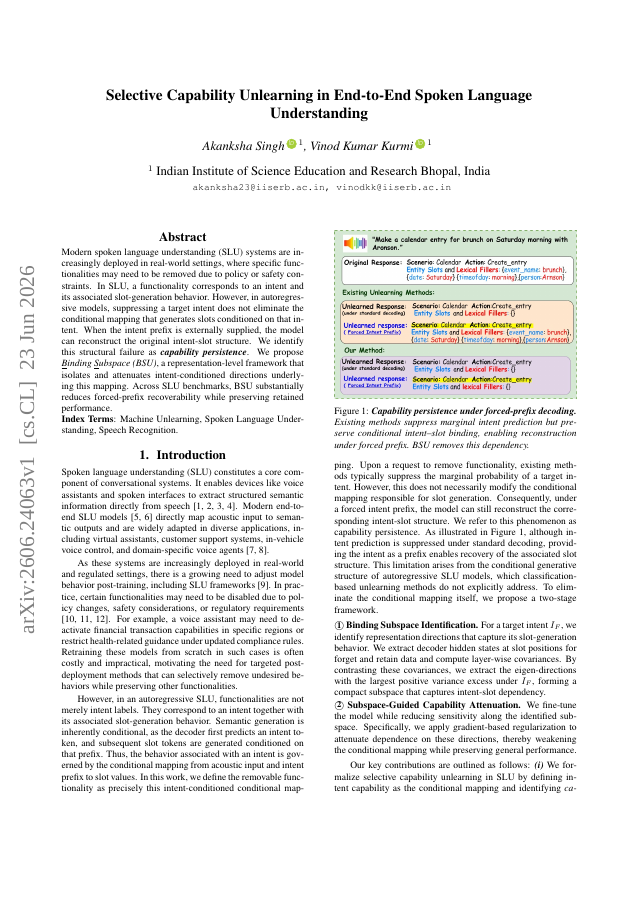
Modern spoken language understanding (SLU) systems are increasingly deployed in real-world settings, where specific functionalities may need to be removed due to policy or safety constraints. In SLU, a functionality corresponds to an intent and its associated slot-generation behavior. However, in autoregressive models, suppressing a target intent does not eliminate the conditional mapping that generates slots conditioned on that intent. When the intent prefix is externally supplied, the model can reconstruct the original intent-slot structure. We identify this structural failure as capability persistence. We propose \textit{\underline{B}inding \underline{S}ubspace (BSU)}, a representation-level framework that isolates and attenuates intent-conditioned directions underlying this mapping. Across SLU benchmarks, BSU substantially reduces forced-prefix recoverability while preserving retained performance.
Selective Capability Unlearning in End-to-End Spoken Language Understanding
Modern spoken language understanding (SLU) systems are increasingly deployed in real-world settings, where specific functionalities may need to be removed due to policy or safety constraints.
- Preview
- Year
- 2026
- Hosting
- Excerpt onlyCC-BY-NC-SA-4.0
Cite
Notes
Only stored in your browser.
Attribution
- Abstract & full text
- arxiv.org/abs/2606.24063CC-BY-NC-SA-4.0
- TL;DR
- Semantic Scholar