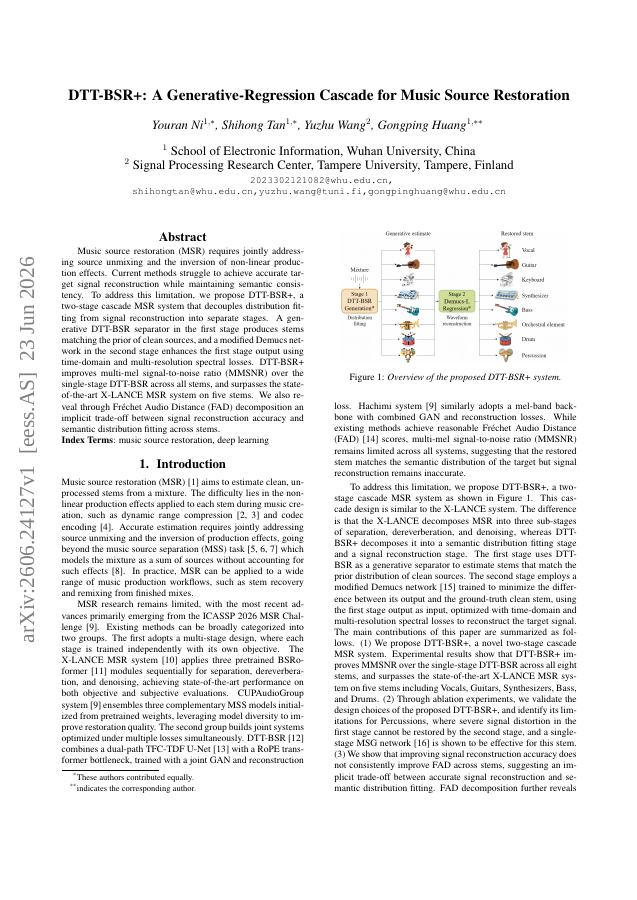
Music source restoration (MSR) requires jointly addressing source unmixing and the inversion of non-linear production effects. Current methods struggle to achieve accurate target signal reconstruction while maintaining semantic consistency. To address this limitation, we propose DTT-BSR+, a two-stage cascade MSR system that decouples distribution fitting from signal reconstruction into separate stages. A generative DTT-BSR separator in the first stage produces stems matching the prior of clean sources, and a modified Demucs network in the second stage enhances the first stage output using time-domain and multi-resolution spectral losses. DTT-BSR+ improves multi-mel signal-to-noise ratio (MMSNR) over the single-stage DTT-BSR across all stems, and surpasses the state-of-the-art X-LANCE MSR system on five stems. We also reveal through Fréchet Audio Distance (FAD) decomposition an implicit trade-off between signal reconstruction accuracy and semantic distribution fitting across stems.
DTT-BSR+: A Generative-Regression Cascade for Music Source Restoration
Music source restoration (MSR) requires jointly addressing source unmixing and the inversion of non-linear production effects. Current methods struggle to achieve accurate target signal reconstruction while maintaining semantic consistency.
- Preview
- Year
- 2026
- Hosting
- Abstract onlyARXIV-DEFAULT
Cite
Notes
Only stored in your browser.
Attribution
- Abstract & full text
- arxiv.org/abs/2606.24127ARXIV-DEFAULT
- TL;DR
- Semantic Scholar