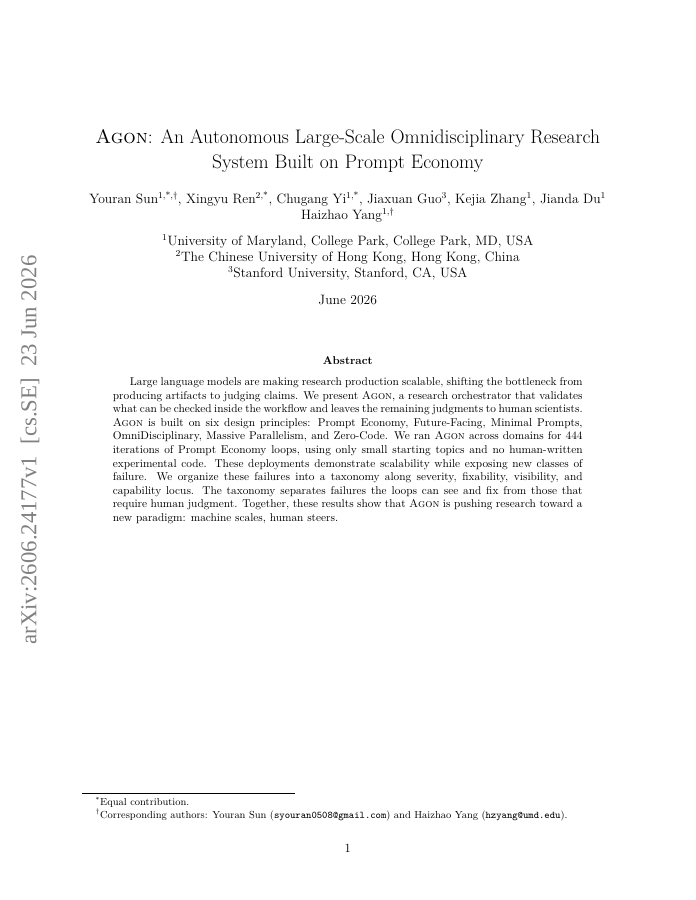
Large language models are making research production scalable, shifting the bottleneck from producing artifacts to judging claims. We present Agon, a research orchestrator that validates what can be checked inside the workflow and leaves the remaining judgments to human scientists. Agon is built on six design principles: Prompt Economy, Future-Facing, Minimal Prompts, OmniDisciplinary, Massive Parallelism, and Zero-Code. We ran Agon across domains for 444 iterations of Prompt Economy loops, using only small starting topics and no human-written experimental code. These deployments demonstrate scalability while exposing new classes of failure. We organize these failures into a taxonomy along severity, fixability, visibility, and capability locus. The taxonomy separates failures the loops can see and fix from those that require human judgment. Together, these results show that Agon is pushing research toward a new paradigm: machine scales, human steers.
Agon: An Autonomous Large-Scale Omnidisciplinary Research System Built on Prompt Economy
Large language models are making research production scalable, shifting the bottleneck from producing artifacts to judging claims. We present \textsc{Agon}, a research orchestrator that validates what can be checked inside the workflow and leaves the remaining judgments to human…
- Preview
- Year
- 2026
- Hosting
- Abstract onlyARXIV-DEFAULT
Cite
Notes
Only stored in your browser.
Attribution
- Abstract & full text
- arxiv.org/abs/2606.24177ARXIV-DEFAULT
- TL;DR
- Semantic Scholar