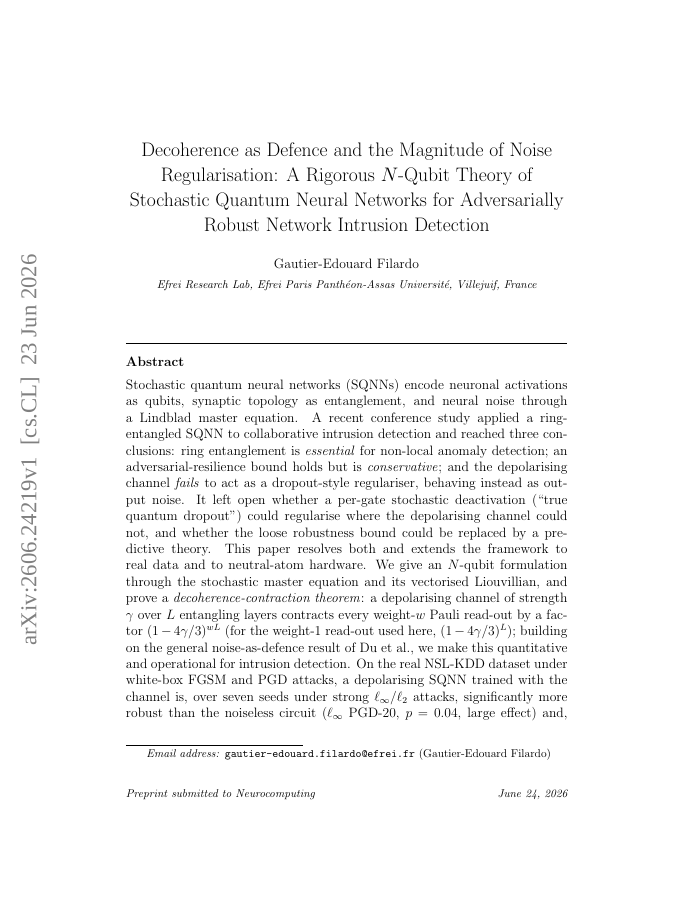
Stochastic quantum neural networks (SQNNs) encode neuronal activations as qubits, synaptic topology as entanglement, and neural noise through a Lindblad master equation. A recent conference study applied a ring-entangled SQNN to collaborative intrusion detection and reached three conclusions: ring entanglement is essential for non-local anomaly detection; an adversarial-resilience bound holds but is conservative; and the depolarising channel fails to act as a dropout-style regulariser, behaving instead as output noise. It left open whether a per-gate stochastic deactivation (``true quantum dropout'') could regularise where the depolarising channel could not, and whether the loose robustness bound could be replaced by a predictive theory. This paper resolves both and extends the framework to real data and to neutral-atom hardware. We give an N-qubit formulation through the stochastic master equation and its vectorised Liouvillian, and prove a decoherence-contraction theorem: a depolarising channel of strength γ over L entangling layers contracts every weight-w Pauli read-out by a factor (1-4γ/3)^{wL} (for the weight-1 read-out used here, (1-4γ/3)^{L}); building on the general noise-as-defence result of Du et al., we make this quantitative and operational for intrusion detection. On the real NSL-KDD dataset under white-box FGSM and PGD attacks, a depolarising SQNN trained with the channel is, over seven seeds under strong \ell_\infty/\ell_2 attacks, significantly more robust than the noiseless circuit (\ell_\infty PGD-20, p=0.04, large effect) and, critically, never suffers the catastrophic robustness collapse that the noiseless model and gradient-trained classical detectors (which fall from 95% to 47%) do, cutting robustness variance roughly twofold; we show this robustness arises from a noise-reshaped training boundary rather than from attack-time gradient contraction. For generalisation, we derive an adaptive-penalty formula showing that per-gate dropout implements a curvature-weighted L_2 penalty \tfrac{p(1-p)}{2}\sumθ^2\partial^2_θL in weight space, maximised at p=1/2, whereas depolarising noise implements an output-space penalty. A 30-seed study confirms the formula's quantitative prediction: both mechanisms reduce the train-test gap by a small but statistically significant margin (\approx!0.01; p<10^{-4} and p=0.004), are statistically indistinguishable from each other, and the effect is concentrated where overfitting is largest; increasing the dropout rate past 1/2 does not help, as the formula predicts. The single-seed dichotomy of prior work does not survive replication. We close with a neutral-atom realisation and a feasibility-by-N analysis.
Decoherence as Defence and the Magnitude of Noise Regularisation: A Rigorous N -Qubit Theory of Stochastic Quantum Neural Networks for Adversarially Robust Network Intrusion Detection
Stochastic quantum neural networks (SQNNs) encode neuronal activations as qubits, synaptic topology as entanglement, and neural noise through a Lindblad master equation.
- Preview
- Year
- 2026
- Hosting
- Abstract onlyARXIV-DEFAULT
Cite
Notes
Only stored in your browser.
Attribution
- Abstract & full text
- arxiv.org/abs/2606.24219ARXIV-DEFAULT
- TL;DR
- Semantic Scholar