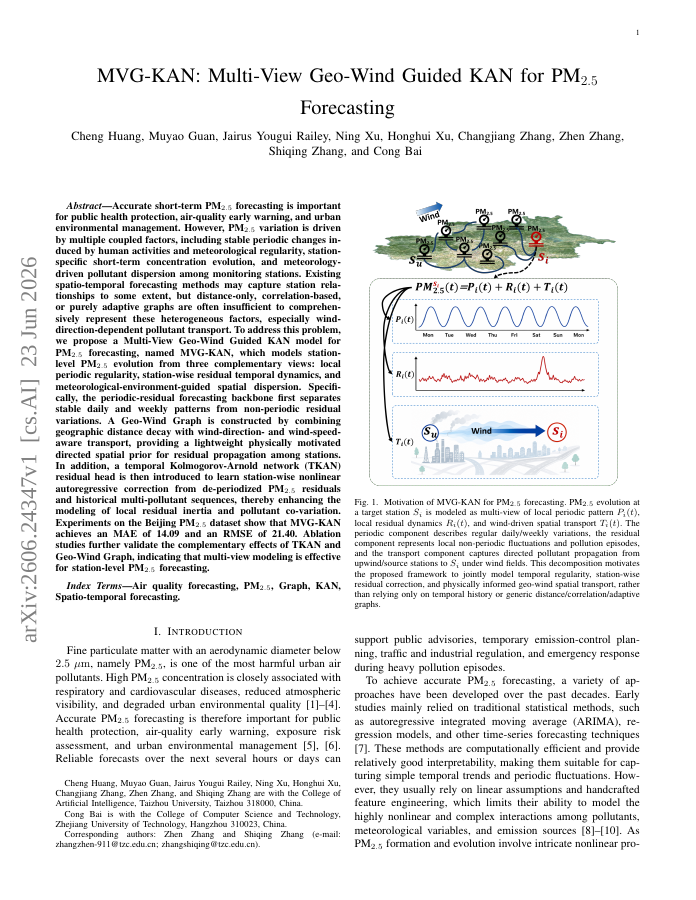
Accurate short-term PM_{2.5} forecasting is important for public health protection, air-quality early warning, and urban environmental management. However, PM_{2.5} variation is driven by multiple coupled factors, including stable periodic changes induced by human activities and meteorological regularity, station-specific short-term concentration evolution, and meteorology-driven pollutant dispersion among monitoring stations. Existing spatio-temporal forecasting methods may capture station relationships to some extent, but distance-only, correlation-based, or purely adaptive graphs are often insufficient to comprehensively represent these heterogeneous factors, especially wind-direction-dependent pollutant transport. To address this problem, we propose a Multi-View Geo-Wind Guided KAN model for PM_{2.5} forecasting, named MVG-KAN, which models station-level PM_{2.5} evolution from three complementary views: local periodic regularity, station-wise residual temporal dynamics, and meteorological-environment-guided spatial dispersion. Specifically, the periodic-residual forecasting backbone first separates stable daily and weekly patterns from non-periodic residual variations. A Geo-Wind Graph is constructed by combining geographic distance decay with wind-direction- and wind-speed-aware transport, providing a lightweight physically motivated directed spatial prior for residual propagation among stations. In addition, a temporal Kolmogorov-Arnold network (TKAN) residual head is then introduced to learn station-wise nonlinear autoregressive correction from de-periodized PM_{2.5} residuals and historical multi-pollutant sequences, thereby enhancing the modeling of local residual inertia and pollutant co-variation.
MVG-KAN: Multi-View Geo-Wind Guided KAN for PM$_{2.5}$ Forecasting
Accurate short-term PM$_{2.5}$ forecasting is important for public health protection, air-quality early warning, and urban environmental management. However, PM$_{2.5}$ variation is driven by multiple coupled factors, including stable periodic changes induced by human activities…
- Preview
- Year
- 2026
- Hosting
- Abstract onlyARXIV-DEFAULT
Cite
Notes
Only stored in your browser.
Attribution
- Abstract & full text
- arxiv.org/abs/2606.24347ARXIV-DEFAULT
- TL;DR
- Semantic Scholar