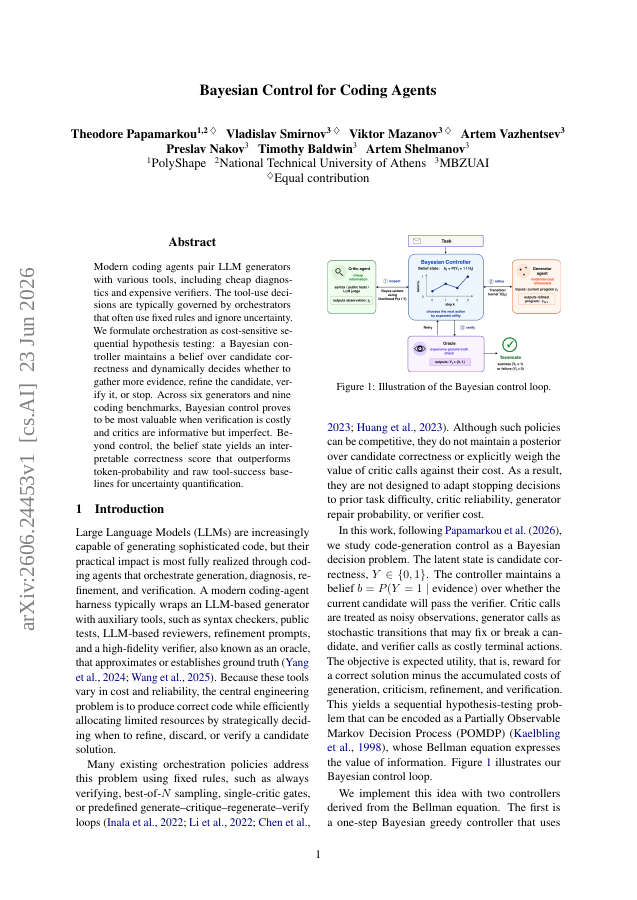
Modern coding agents pair LLM generators with various tools, including cheap diagnostics and expensive verifiers. The tool-use decisions are typically governed by orchestrators that often use fixed rules and ignore uncertainty. We formulate orchestration as cost-sensitive sequential hypothesis testing: a Bayesian controller maintains a belief over candidate correctness and dynamically decides whether to gather more evidence, refine the candidate, verify it, or stop. Across six generators and nine coding benchmarks, Bayesian control proves to be most valuable when verification is costly and critics are informative but imperfect. Beyond control, the belief state yields an interpretable correctness score that outperforms token-probability and raw tool-success baselines for uncertainty quantification.
Bayesian control for coding agents
Modern coding agents pair LLM generators with various tools, including cheap diagnostics and expensive verifiers. The tool-use decisions are typically governed by orchestrators that often use fixed rules and ignore uncertainty.
- Preview
- Year
- 2026
- Hosting
- Abstract onlyARXIV-DEFAULT
Cite
Notes
Only stored in your browser.
Attribution
- Abstract & full text
- arxiv.org/abs/2606.24453ARXIV-DEFAULT
- TL;DR
- Semantic Scholar