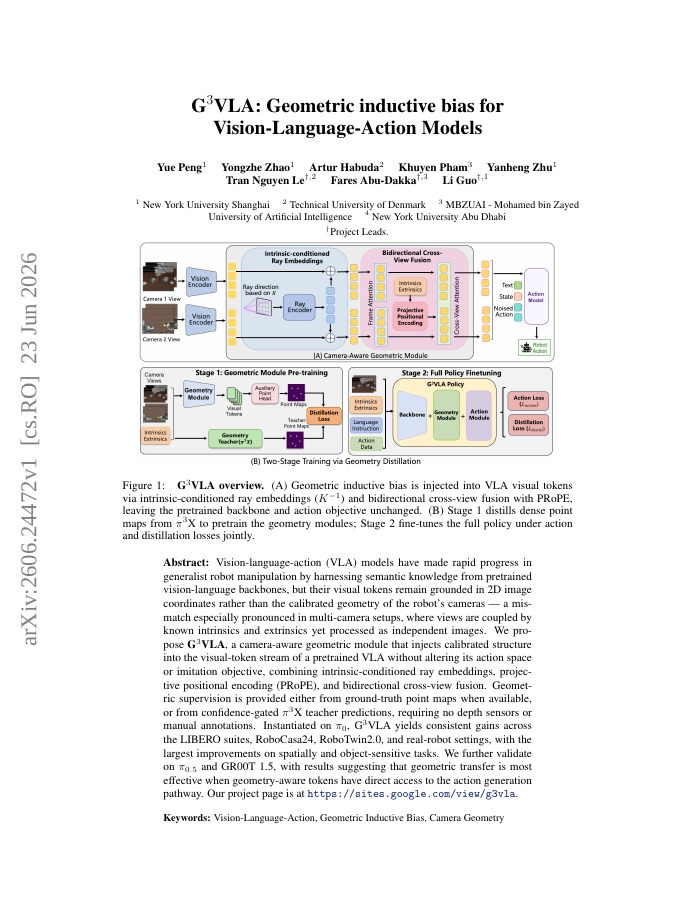
Vision-language-action (VLA) models have made rapid progress in generalist robot manipulation by harnessing semantic knowledge from pretrained vision-language backbones, but their visual tokens remain grounded in 2D image coordinates rather than the calibrated geometry of the robot's cameras -- a mismatch especially pronounced in multi-camera setups, where views are coupled by known intrinsics and extrinsics yet processed as independent images. We propose G^3VLA, a camera-aware geometric module that injects calibrated structure into the visual-token stream of a pretrained VLA without altering its action space or imitation objective, combining intrinsic-conditioned ray embeddings, projective positional encoding (PRoPE), and bidirectional cross-view fusion. Geometric supervision is provided either from ground-truth point maps when available, or from confidence-gated π^3X teacher predictions, requiring no depth sensors or manual annotations. Instantiated on π_0, G^3VLA yields consistent gains across the LIBERO suites, RoboCasa24, RoboTwin2.0, and real-robot settings, with the largest improvements on spatially and object-sensitive tasks. We further validate on π_{0.5} and GR00T 1.5, with results suggesting that geometric transfer is most effective when geometry-aware tokens have direct access to the action generation pathway. Our project page is at https://sites.google.com/view/g3vla
G$^3$VLA: Geometric inductive bias for Vision-Language-Action Models
Vision-language-action (VLA) models have made rapid progress in generalist robot manipulation by harnessing semantic knowledge from pretrained vision-language backbones, but their visual tokens remain grounded in 2D image coordinates rather than the calibrated geometry of the…
- Preview
- Year
- 2026
- Hosting
- Full text hostedCC-BY-4.0
Cite
Notes
Only stored in your browser.
Attribution
- Abstract & full text
- arxiv.org/abs/2606.24472CC-BY-4.0
- TL;DR
- Semantic Scholar