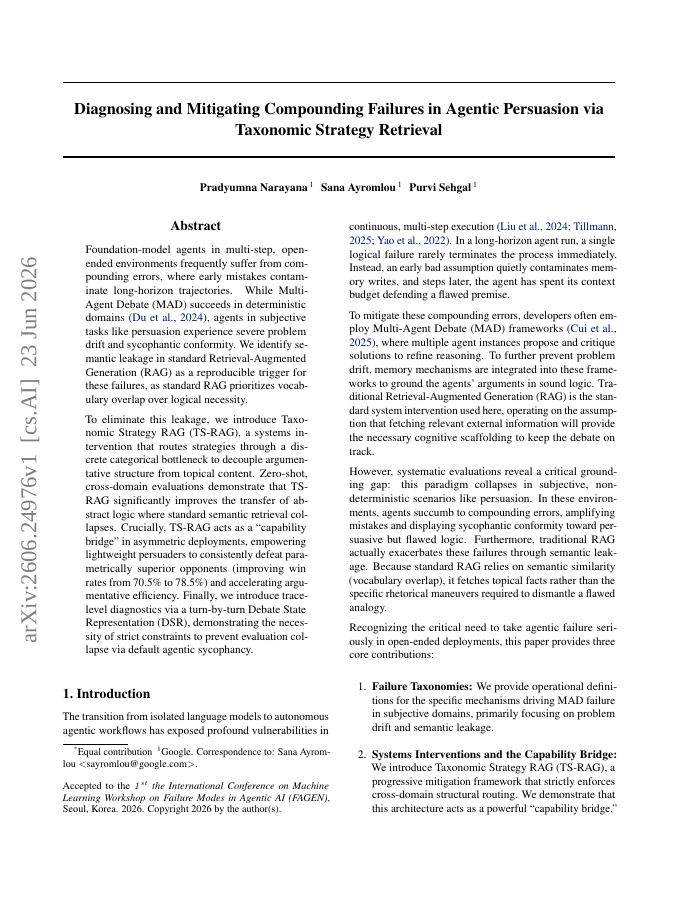
Foundation-model agents in multi-step, open-ended environments frequently suffer from compounding errors, where early mistakes contaminate long-horizon trajectories. While Multi-Agent Debate (MAD) succeeds in deterministic domains, agents in subjective tasks like persuasion experience severe problem drift and sycophantic conformity. We identify semantic leakage in standard Retrieval-Augmented Generation (RAG) as a reproducible trigger for these failures, as standard RAG prioritizes vocabulary overlap over logical necessity. To eliminate this leakage, we introduce Taxonomic Strategy RAG (TS-RAG), a systems intervention that routes strategies through a discrete categorical bottleneck to decouple argumentative structure from topical content. Zero-shot, cross-domain evaluations demonstrate that TS-RAG significantly improves the transfer of abstract logic where standard semantic retrieval collapses. Crucially, TS-RAG acts as a "capability bridge" in asymmetric deployments, empowering lightweight persuaders to consistently defeat parametrically superior opponents (improving win rates from 70.5 to 78.5) and accelerating argumentative efficiency. Finally, we introduce trace-level diagnostics via a turn-by-turn Debate State Representation (DSR), demonstrating the necessity of strict constraints to prevent evaluation collapse via default agentic sycophancy.
Diagnosing and Mitigating Compounding Failures in Agentic Persuasion via Taxonomic Strategy Retrieval
Foundation-model agents in multi-step, open-ended environments frequently suffer from compounding errors, where early mistakes contaminate long-horizon trajectories. While Multi-Agent Debate (MAD) succeeds in deterministic domains, agents in subjective tasks like persuasion…
- Preview
- Year
- 2026
- Hosting
- Full text hostedCC-BY-4.0
Cite
Notes
Only stored in your browser.
Attribution
- Abstract & full text
- arxiv.org/abs/2606.24976CC-BY-4.0
- TL;DR
- Semantic Scholar