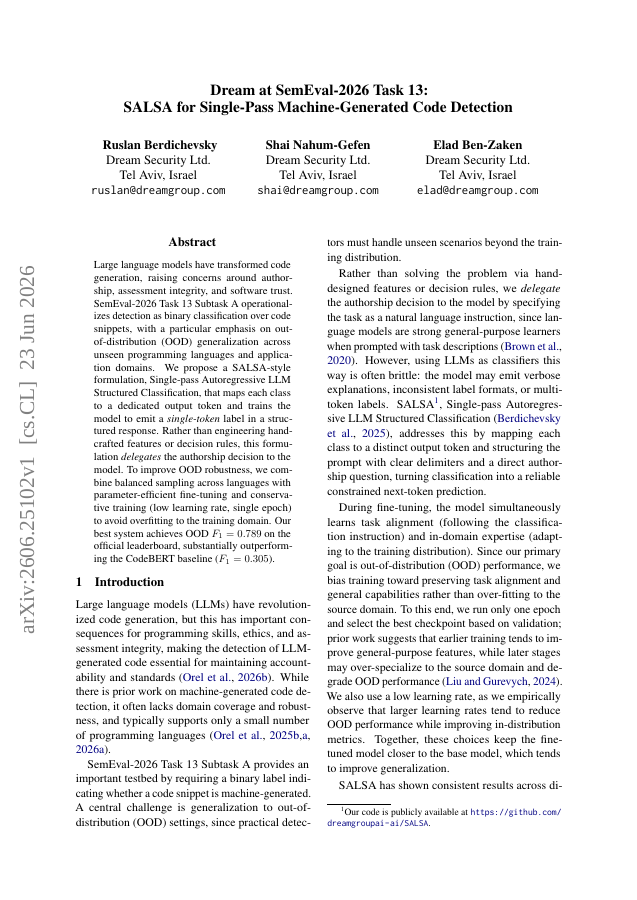
Large language models have transformed code generation, raising concerns around authorship, assessment integrity, and software trust. SemEval-2026 Task 13 Subtask A operationalizes detection as binary classification over code snippets, with a particular emphasis on out-of-distribution (OOD) generalization across unseen programming languages and application domains. We propose a SALSA-style formulation, Single-pass Autoregressive LLM Structured Classification, that maps each class to a dedicated output token and trains the model to emit a single-token label in a structured response. Rather than engineering hand-crafted features or decision rules, this formulation delegates the authorship decision to the model. To improve OOD robustness, we combine balanced sampling across languages with parameter-efficient fine-tuning and conservative training (low learning rate, single epoch) to avoid overfitting to the training domain. Our best system achieves OOD F_1 = 0.789 on the official leaderboard, substantially outperforming the CodeBERT baseline (F_1 = 0.305).
Dream at SemEval-2026 Task 13: SALSA for Single-Pass Machine-Generated Code Detection
Large language models have transformed code generation, raising concerns around authorship, assessment integrity, and software trust. SemEval-2026 Task 13 Subtask A operationalizes detection as binary classification over code snippets, with a particular emphasis on…
- Preview
- Year
- 2026
- Hosting
- Full text hostedCC-BY-4.0
Cite
Notes
Only stored in your browser.
Attribution
- Abstract & full text
- arxiv.org/abs/2606.25102CC-BY-4.0
- TL;DR
- Semantic Scholar