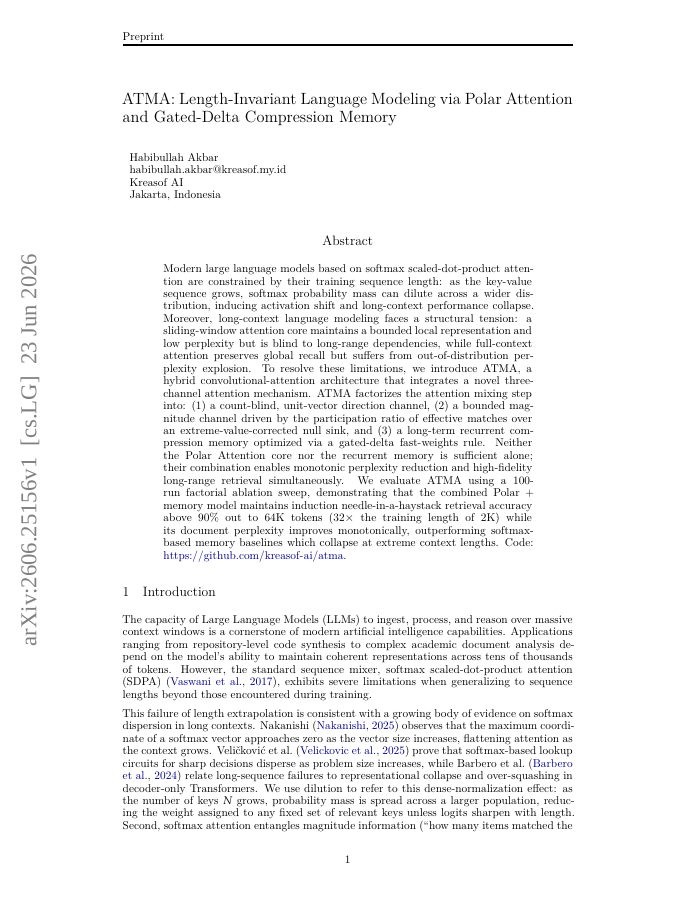
Modern large language models based on softmax scaled-dot-product attention are constrained by their training sequence length: as the key-value sequence grows, softmax probability mass can dilute across a wider distribution, inducing activation shift and long-context performance collapse. Moreover, long-context language modeling faces a structural tension: a sliding-window attention core maintains a bounded local representation and low perplexity but is blind to long-range dependencies, while full-context attention preserves global recall but suffers from out-of-distribution perplexity explosion. To resolve these limitations, we introduce ATMA, a hybrid convolutional-attention architecture that integrates a novel three-channel attention mechanism. ATMA factorizes the attention mixing step into: (1) a count-blind, unit-vector direction channel, (2) a bounded magnitude channel driven by the participation ratio of effective matches over an extreme-value-corrected null sink, and (3) a long-term recurrent compression memory optimized via a gated-delta fast-weights rule. Neither the Polar Attention core nor the recurrent memory is sufficient alone; their combination enables monotonic perplexity reduction and high-fidelity long-range retrieval simultaneously. We evaluate ATMA using a 100-run factorial ablation sweep, demonstrating that the combined Polar + memory model maintains induction needle-in-a-haystack retrieval accuracy above 90% out to 64K tokens (32 times the training length of 2K) while its document perplexity improves monotonically, outperforming softmax-based memory baselines which collapse at extreme context lengths. Code: https://github.com/kreasof-ai/atma
ATMA: Length-Invariant Language Modeling via Polar Attention and Gated-Delta Compression Memory
Modern large language models based on softmax scaled-dot-product attention are constrained by their training sequence length: as the key-value sequence grows, softmax probability mass can dilute across a wider distribution, inducing activation shift and long-context performance…
- Preview
- Year
- 2026
- Hosting
- Full text hostedCC-BY-4.0
Cite
Notes
Only stored in your browser.
Attribution
- Abstract & full text
- arxiv.org/abs/2606.25156CC-BY-4.0
- TL;DR
- Semantic Scholar