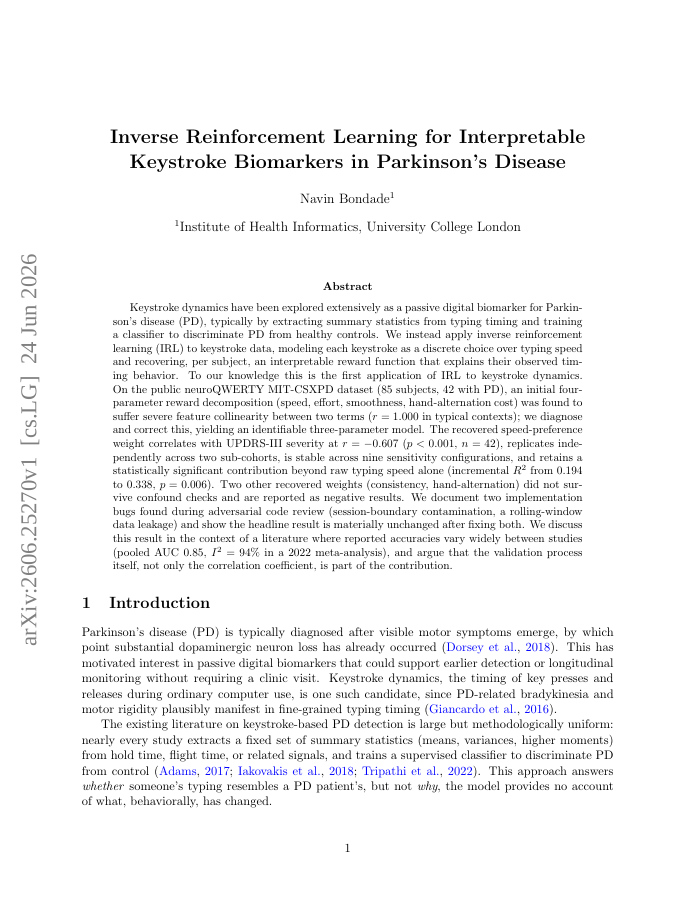
Keystroke dynamics have been explored extensively as a passive digital biomarker for Parkinson's disease (PD), typically by extracting summary statistics from typing timing and training a classifier to discriminate PD from healthy controls. We instead apply inverse reinforcement learning (IRL) to keystroke data, modeling each keystroke as a discrete choice over typing speed and recovering, per subject, an interpretable reward function that explains their observed timing behavior. To our knowledge this is the first application of IRL to keystroke dynamics. On the public neuroQWERTY MIT-CSXPD dataset (85 subjects, 42 with PD), an initial four-parameter reward decomposition (speed, effort, smoothness, hand-alternation cost) was found to suffer severe feature collinearity between two terms (r=1.000 in typical contexts); we diagnose and correct this, yielding an identifiable three-parameter model. The recovered speed-preference weight correlates with UPDRS-III severity at r=-0.607 (p<0.001, n=42), replicates independently across two sub-cohorts, is stable across nine sensitivity configurations, and retains a statistically significant contribution beyond raw typing speed alone (incremental R^2 from 0.194 to 0.338, p=0.006). Two other recovered weights (consistency, hand-alternation) did not survive confound checks and are reported as negative results. We document two implementation bugs found during adversarial code review (session-boundary contamination, a rolling-window data leakage) and show the headline result is materially unchanged after fixing both. We discuss this result in the context of a literature where reported accuracies vary widely between studies (pooled AUC 0.85, I^2=94% in a 2022 meta-analysis), and argue that the validation process itself, not only the correlation coefficient, is part of the contribution.
Inverse Reinforcement Learning for Interpretable Keystroke Biomarkers in Parkinson's Disease
Keystroke dynamics have been explored extensively as a passive digital biomarker for Parkinson's disease (PD), typically by extracting summary statistics from typing timing and training a classifier to discriminate PD from healthy controls.
- Preview
- Year
- 2026
- Hosting
- Full text hostedCC-BY-4.0
Cite
Notes
Only stored in your browser.
Attribution
- Abstract & full text
- arxiv.org/abs/2606.25270CC-BY-4.0
- TL;DR
- Semantic Scholar