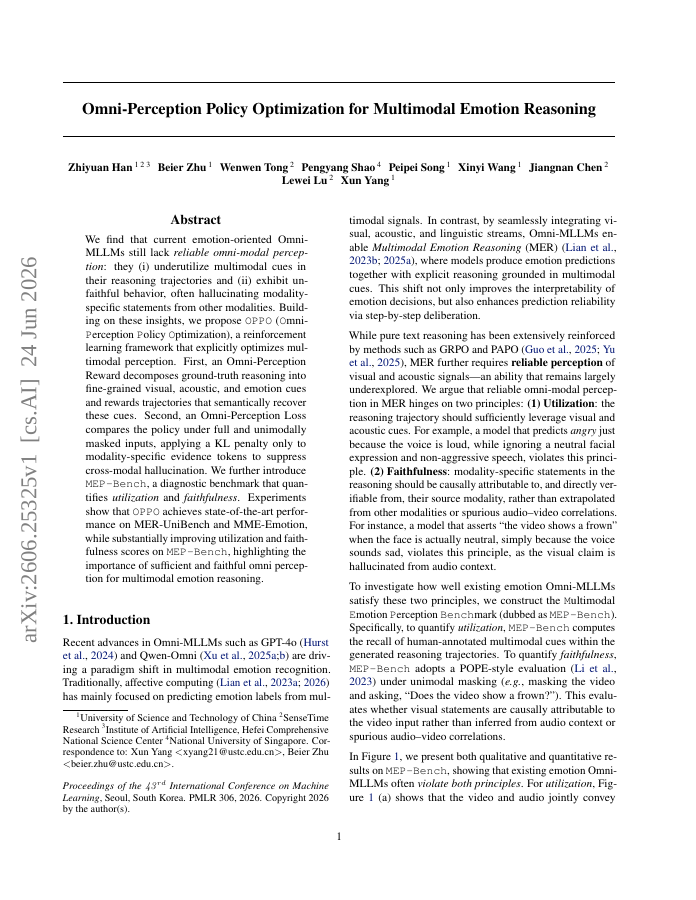
We find that current emotion-oriented Omni-MLLMs still lack reliable omni-modal perception: they (i) underutilize multimodal cues in their reasoning trajectories and (ii) exhibit unfaithful behavior, often hallucinating modality-specific statements from other modalities. Building on these insights, we propose OPPO (Omni-Perception Policy Optimization), a reinforcement learning framework that explicitly optimizes multimodal perception. First, an Omni-Perception Reward decomposes ground-truth reasoning into fine-grained visual, acoustic, and emotion cues and rewards trajectories that semantically recover these cues. Second, an Omni-Perception Loss compares the policy under full and unimodally masked inputs, applying a KL penalty only to modality-specific evidence tokens to suppress cross-modal hallucination. We further introduce MEP-Bench, a diagnostic benchmark that quantifies utilization and faithfulness. Experiments show that OPPO achieves state-of-the-art performance on MER-UniBench and MME-Emotion, while substantially improving utilization and faithfulness scores on MEP-Bench, highlighting the importance of sufficient and faithful omni perception for multimodal emotion reasoning.
Omni-Perception Policy Optimization for Multimodal Emotion Reasoning
We find that current emotion-oriented Omni-MLLMs still lack reliable omni-modal perception: they (i) underutilize multimodal cues in their reasoning trajectories and (ii) exhibit unfaithful behavior, often hallucinating modality-specific statements from other modalities.
- Preview
- Year
- 2026
- Hosting
- Full text hostedCC-BY-4.0
Cite
Notes
Only stored in your browser.
Attribution
- Abstract & full text
- arxiv.org/abs/2606.25325CC-BY-4.0
- TL;DR
- Semantic Scholar