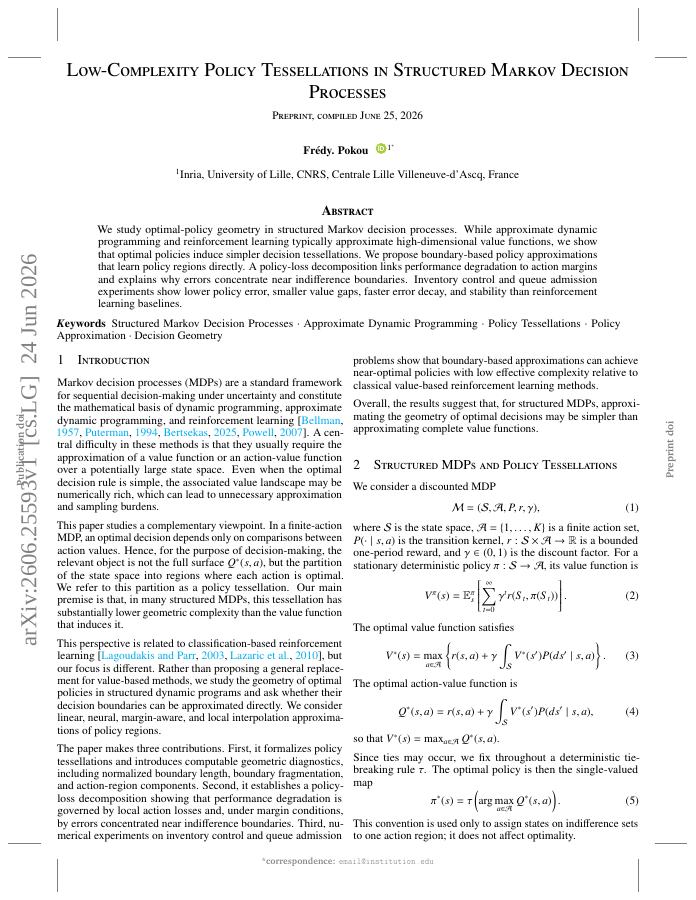
We study optimal-policy geometry in structured Markov decision processes. While approximate dynamic programming and reinforcement learning typically approximate high-dimensional value functions, we show that optimal policies induce simpler decision tessellations. We propose boundary-based policy approximations that learn policy regions directly. A policy-loss decomposition links performance degradation to action margins and explains why errors concentrate near indifference boundaries. Inventory control and queue admission experiments show lower policy error, smaller value gaps, faster error decay, and stability than reinforcement learning baselines.
Low-Complexity Policy Tessellations in Structured Markov Decision Processes
We study optimal-policy geometry in structured Markov decision processes. While approximate dynamic programming and reinforcement learning typically approximate high-dimensional value functions, we show that optimal policies induce simpler decision tessellations.
- Preview
- Year
- 2026
- Hosting
- Abstract onlyARXIV-DEFAULT
Cite
Notes
Only stored in your browser.
Attribution
- Abstract & full text
- arxiv.org/abs/2606.25593ARXIV-DEFAULT
- TL;DR
- Semantic Scholar