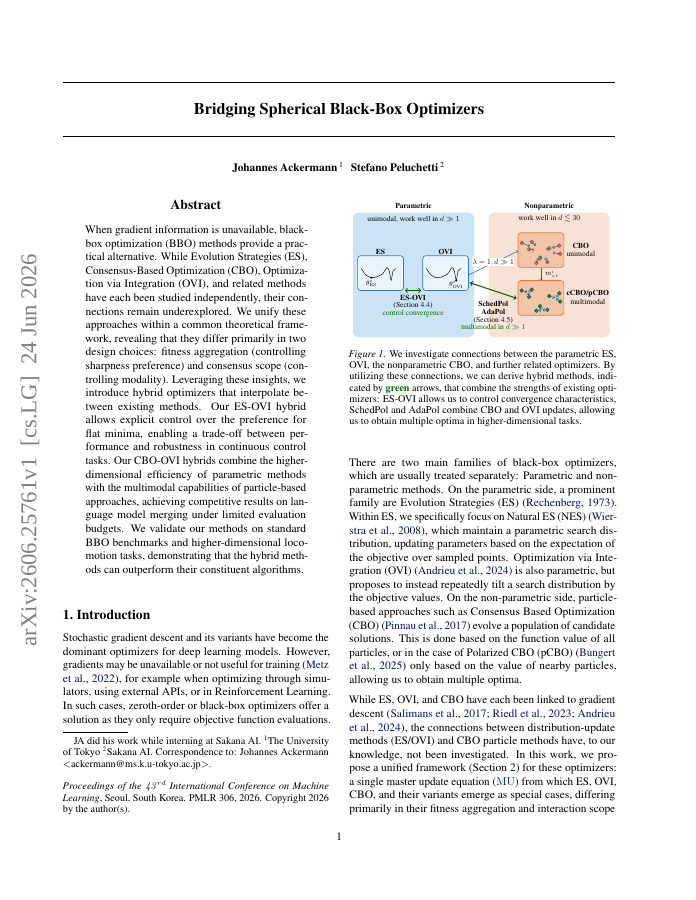
When gradient information is unavailable, black-box optimization (BBO) methods provide a practical alternative. While Evolution Strategies (ES), Consensus-Based Optimization (CBO), Optimization via Integration (OVI), and related methods have each been studied independently, their connections remain underexplored. We unify these approaches within a common theoretical framework, revealing that they differ primarily in two design choices: fitness aggregation (controlling sharpness preference) and consensus scope (controlling modality). Leveraging these insights, we introduce hybrid optimizers that interpolate between existing methods. Our ES-OVI hybrid allows explicit control over the preference for flat minima, enabling a trade-off between performance and robustness in continuous control tasks. Our CBO-OVI hybrids combine the higher-dimensional efficiency of parametric methods with the multimodal capabilities of particle-based approaches, achieving competitive results on language model merging under limited evaluation budgets. We validate our methods on standard BBO benchmarks and higher-dimensional locomotion tasks, demonstrating that the hybrid methods can outperform their constituent algorithms.
Bridging Spherical Black-Box Optimizers
When gradient information is unavailable, black-box optimization (BBO) methods provide a practical alternative. While Evolution Strategies (ES), Consensus-Based Optimization (CBO), Optimization via Integration (OVI), and related methods have each been studied independently,…
- Preview
- Year
- 2026
- Hosting
- Full text hostedCC-BY-4.0
Cite
Notes
Only stored in your browser.
Attribution
- Abstract & full text
- arxiv.org/abs/2606.25761CC-BY-4.0
- TL;DR
- Semantic Scholar