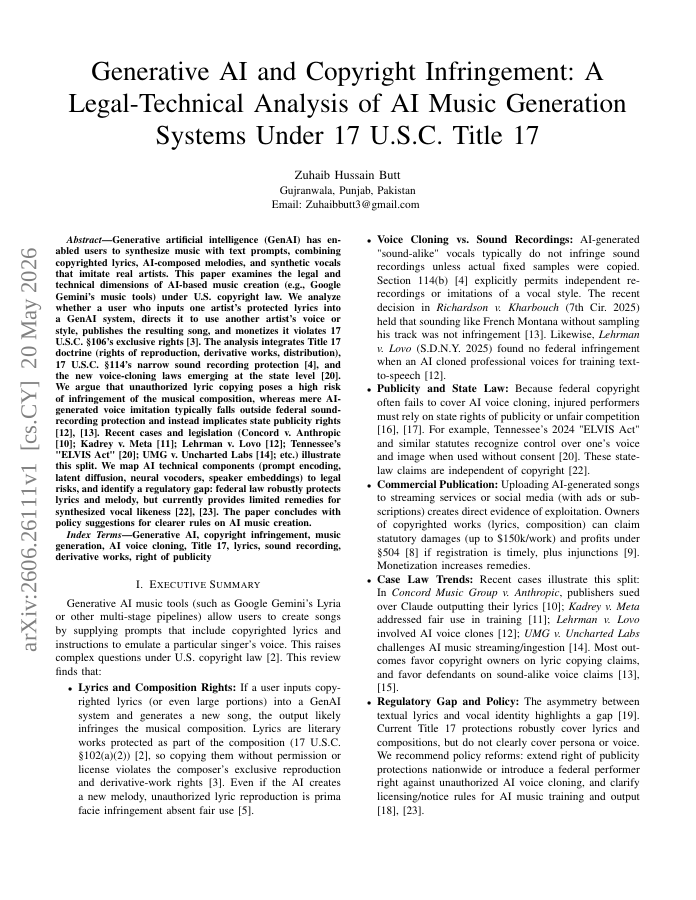
Generative artificial intelligence (GenAI) has enabled users to synthesize music with text prompts, combining copyrighted lyrics, AI-composed melodies, and synthetic vocals that imitate real artists. This paper examines the legal and technical dimensions of AI-based music creation (e.g., Google Gemini's music tools) under U.S. copyright law. We analyze whether a user who inputs one artist's protected lyrics into a GenAI system, directs it to use another artist's voice or style, publishes the resulting song, and monetizes it violates 17 U.S.C. Section 106's exclusive rights [3]. The analysis integrates Title 17 doctrine (rights of reproduction, derivative works, distribution), 17 U.S.C. Section 114's narrow sound recording protection [4], and the new voice-cloning laws emerging at the state level [20]. We argue that unauthorized lyric copying poses a high risk of infringement of the musical composition, whereas mere AI-generated voice imitation typically falls outside federal sound recording protection and instead implicates state publicity rights [12], [13]. Recent cases and legislation (Concord v. Anthropic [10]; Kadrey v. Meta [11]; Lehrman v. Lovo [12]; Tennessee's "ELVIS Act" [20]; UMG v. Uncharted Labs [14]; etc.) illustrate this split. We map AI technical components (prompt encoding, latent diffusion, neural vocoders, speaker embeddings) to legal risks and identify a regulatory gap: federal law robustly protects lyrics and melody but currently provides limited remedies for synthesized vocal likeness [22], [23]. The paper concludes with policy suggestions for clearer rules on AI music creation.
Generative AI and Copyright Infringement: A Legal-Technical Analysis of AI Music Generation Systems Under 17 U.S.C. Title 17
Generative artificial intelligence (GenAI) has enabled users to synthesize music with text prompts, combining copyrighted lyrics, AI-composed melodies, and synthetic vocals that imitate real artists.
- Preview
- Year
- 2026
- Hosting
- Full text hostedCC-BY-4.0
Cite
Notes
Only stored in your browser.
Attribution
- Abstract & full text
- arxiv.org/abs/2606.26111CC-BY-4.0
- TL;DR
- Semantic Scholar