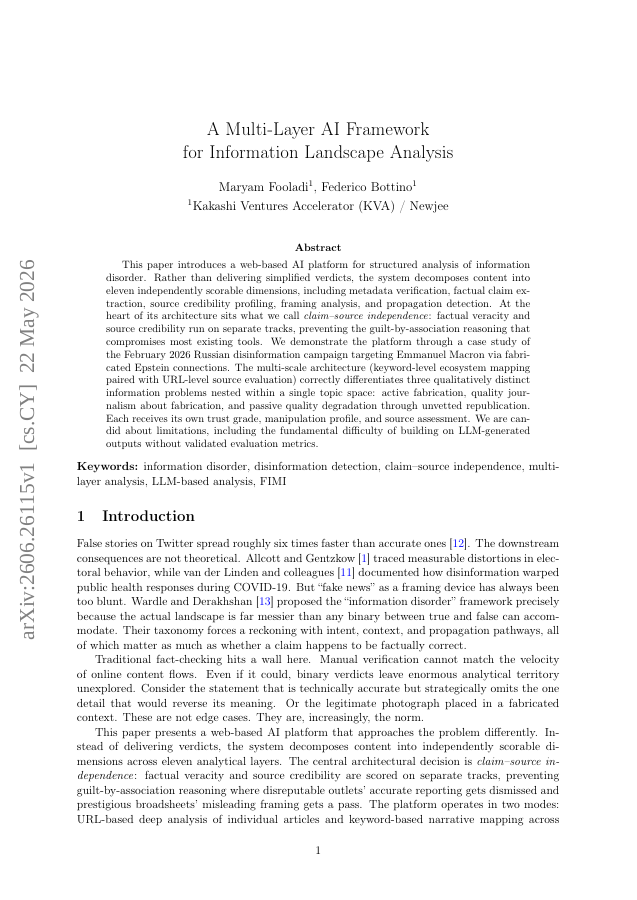
This paper proposes a multi-layer AI framework for information landscape analysis in the context of information disorder. Rather than treating misinformation detection as a binary fact-checking task, the framework analyzes political and media content across multiple dimensions, including source reliability, factual structure, framing, bias, emotional activation, manipulation patterns, and propagation dynamics. The goal is to move beyond isolated claim verification toward a structured representation of the informational environment surrounding an event, entity, or narrative. We argue that AI systems for media analysis should support epistemic mapping: a transparent, multi-dimensional account of how facts, interpretations, actors, and narratives interact over time. The paper presents the conceptual architecture, analytical layers, and methodological rationale of the framework, with the aim of supporting more nuanced, explainable, and critically useful tools for information disorder research.
A Multi-Layer AI Framework for Information Landscape Analysis
This paper proposes a multi-layer AI framework for information landscape analysis in the context of information disorder. Rather than treating misinformation detection as a binary fact-checking task, the framework analyzes political and media content across multiple dimensions,…
- Preview
- Year
- 2026
- Hosting
- Excerpt onlyCC-BY-NC-SA-4.0
Cite
Notes
Only stored in your browser.
Attribution
- Abstract & full text
- arxiv.org/abs/2606.26115CC-BY-NC-SA-4.0
- TL;DR
- Semantic Scholar