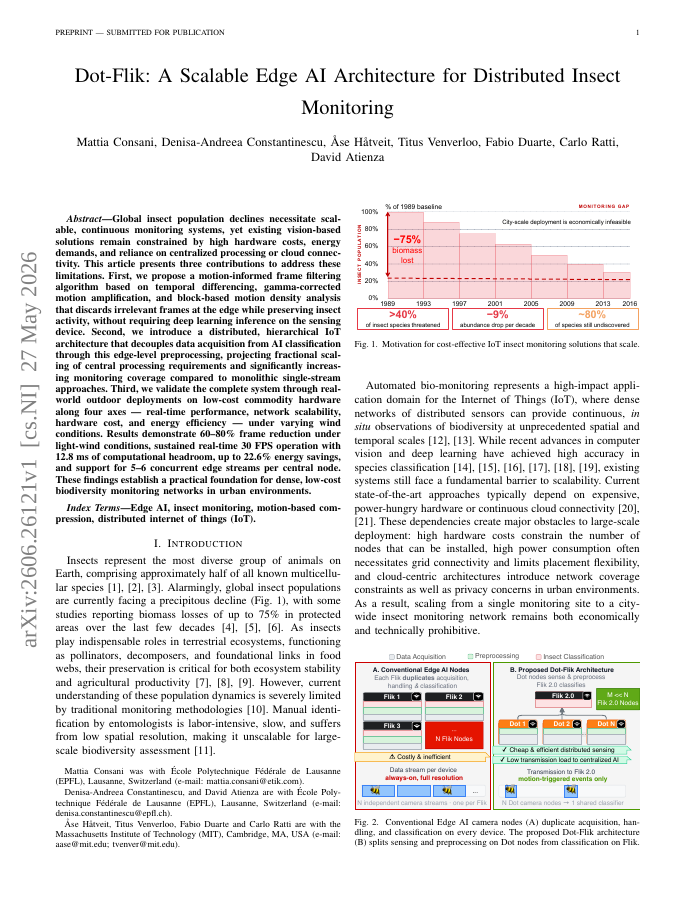
Global insect population declines necessitate scalable, continuous monitoring systems, yet existing vision-based solutions remain constrained by high hardware costs, energy demands, and reliance on centralized processing or cloud connectivity. This article presents three contributions to address these limitations. First, we propose a motion-informed frame filtering algorithm based on temporal differencing, gamma-corrected motion amplification, and block-based motion density analysis that discards irrelevant frames at the edge while preserving insect activity, without requiring deep learning inference on the sensing device. Second, we introduce a distributed, hierarchical IoT architecture that decouples data acquisition from AI classification through this edge-level preprocessing, projecting fractional scaling of central processing requirements and significantly increasing monitoring coverage compared to monolithic single-stream approaches. Third, we validate the complete system through real-world outdoor deployments on low-cost commodity hardware along four axes: real-time performance, network scalability, hardware cost, and energy efficiency under varying wind conditions. Results demonstrate 60-80% frame reduction under light-wind conditions, sustained real-time 30 FPS operation with 12.8 ms of computational headroom, up to 22.6% energy savings, and support for 5-6 concurrent edge streams per central node. These findings establish a practical foundation for dense, low-cost biodiversity monitoring networks in urban environments.
Dot-Flik: A Scalable Edge AI Architecture for Distributed Insect Monitoring
Global insect population declines necessitate scalable, continuous monitoring systems, yet existing vision-based solutions remain constrained by high hardware costs, energy demands, and reliance on centralized processing or cloud connectivity.
- Preview
- Year
- 2026
- Hosting
- Full text hostedCC-BY-4.0
Cite
Notes
Only stored in your browser.
Attribution
- Abstract & full text
- arxiv.org/abs/2606.26121CC-BY-4.0
- TL;DR
- Semantic Scholar