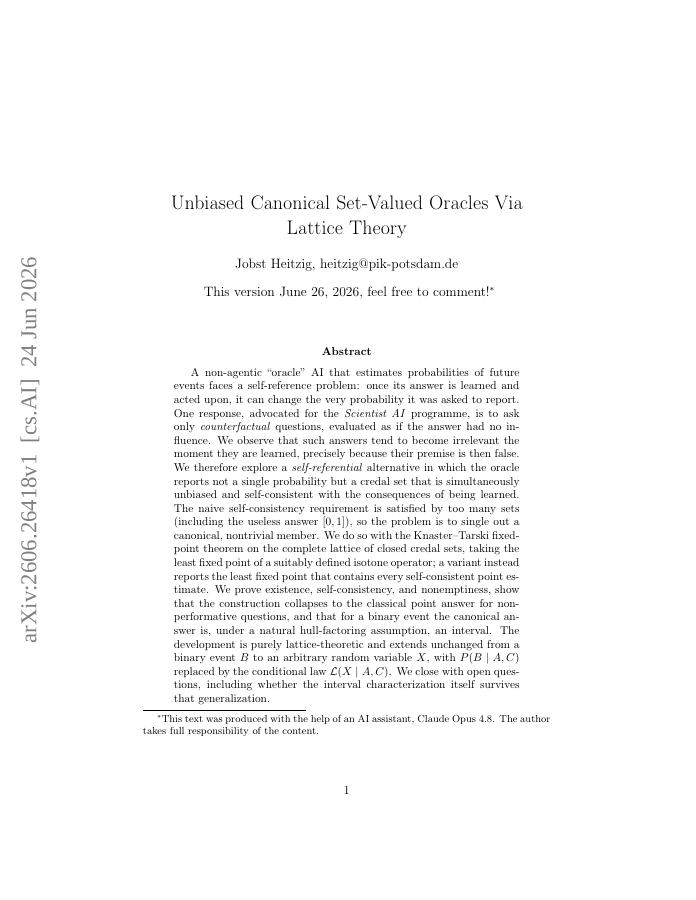
A non-agentic "oracle" that reports probabilities of future events is performative: once its answer is learned and acted upon, it can change the very probability it was asked to report. Performativity is not in itself the difficulty -- one consults an oracle precisely in order to be informed, and hence influenced, by it. The difficulty is agency. The requirement that a report be self-consistent, still holding once announced, may be met by many different values -- the classical non-uniqueness of self-fulfilling prophecies -- and any rule the system uses to choose among them is a lever for goal-directed steering. We remove the choice rather than the performativity. Reporting a credal set instead of a single probability distribution, we lift the reaction to an isotone operator on the complete lattice of closed credal sets, whose fixed points are self-consistent, and report its Knaster--Tarski least fixed point as a canonical, rule-determined answer; a variant reports instead the least fixed point that contains every self-consistent point estimate. We prove existence, self-consistency, and nonemptiness; show that the construction reduces to the classical point answer when the question is non-performative; and show that for a binary event the answer is, under a natural hull-factoring assumption, an interval.
Unbiased Canonical Set-Valued Oracles Via Lattice Theory
A non-agentic "oracle" that reports probabilities of future events is performative: once its answer is learned and acted upon, it can change the very probability it was asked to report.
- Preview
- Year
- 2026
- Hosting
- Full text hostedCC-BY-4.0
Cite
Notes
Only stored in your browser.
Attribution
- Abstract & full text
- arxiv.org/abs/2606.26418CC-BY-4.0
- TL;DR
- Semantic Scholar