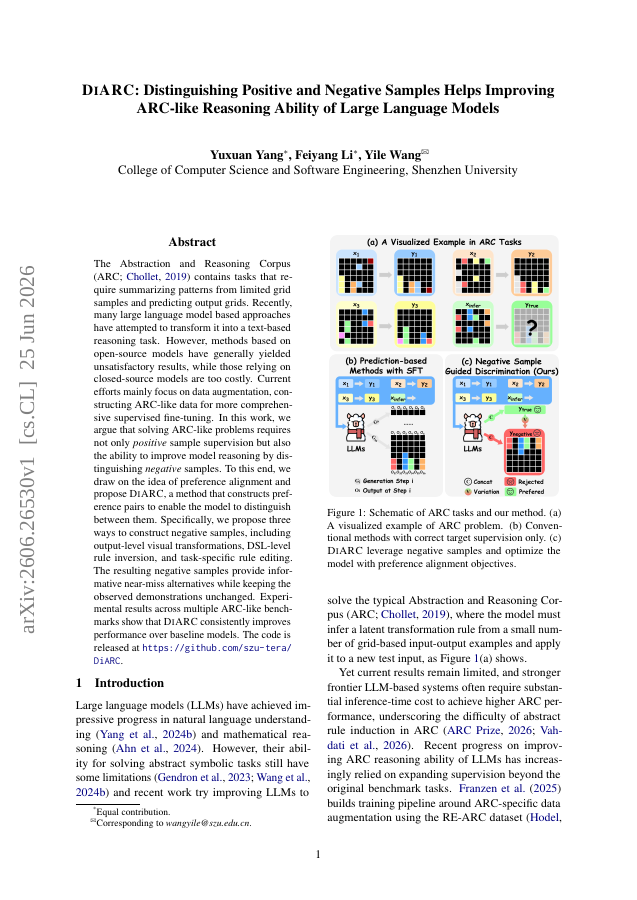
The Abstraction and Reasoning Corpus (ARC; \citealp{chollet2019measure}) contains tasks that require summarizing patterns from limited grid samples and predicting output grids. Recently, many large language model based approaches have attempted to transform it into a text-based reasoning task. However, methods based on open-source models have generally yielded unsatisfactory results, while those relying on closed-source models are too costly. Current efforts mainly focus on data augmentation, constructing ARC-like data for more comprehensive supervised fine-tuning. In this work, we argue that solving ARC-like problems requires not only positive sample supervision but also the ability to improve model reasoning by distinguishing negative samples. To this end, we draw on the idea of preference alignment and propose DiARC, a method that constructs preference pairs to enable the model to distinguish between them. Specifically, we propose three ways to construct negative samples, including output-level visual transformations, DSL-level rule inversion, and task-specific rule editing. The resulting negative samples provide informative near-miss alternatives while keeping the observed demonstrations unchanged. Experimental results across multiple ARC-like benchmarks show that DiARC consistently improves performance over baseline models. The code is released at https://github.com/szu-tera/DiARC.
\textsc{DiARC}: Distinguishing Positive and Negative Samples Helps Improving ARC-like Reasoning Ability of Large Language Models
The Abstraction and Reasoning Corpus (ARC;~\citealp{chollet2019measure}) contains tasks that require summarizing patterns from limited grid samples and predicting output grids.
- Preview
- Year
- 2026
- Hosting
- Full text hostedCC-BY-4.0
Cite
Notes
Only stored in your browser.
Attribution
- Abstract & full text
- arxiv.org/abs/2606.26530CC-BY-4.0
- TL;DR
- Semantic Scholar