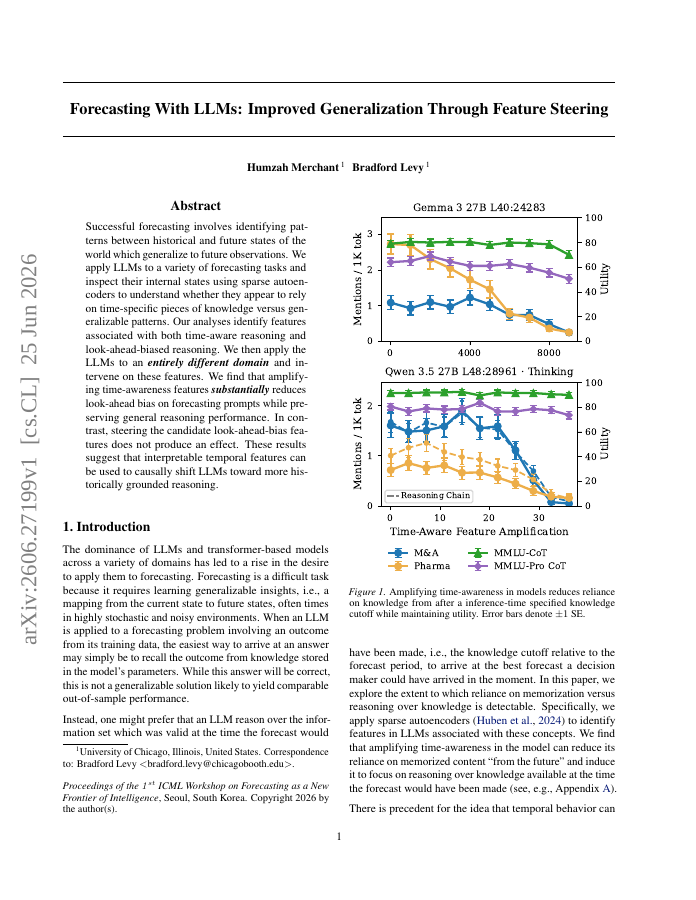
Successful forecasting involves identifying patterns between historical and future states of the world which generalize to future observations. We apply LLMs to a variety of forecasting tasks and inspect their internal states using sparse autoencoders to understand whether they appear to rely on time-specific pieces of knowledge versus generalizable patterns. Our analyses identify features associated with both time-aware reasoning and look-ahead-biased reasoning. We then apply the LLMs to an entirely different domain and intervene on these features. We find that amplifying time-awareness features substantially reduces look-ahead bias on forecasting prompts while preserving general reasoning performance. In contrast, steering the candidate look-ahead-bias features does not produce an effect. These results suggest that interpretable temporal features can be used to causally shift LLMs toward more historically grounded reasoning.
Forecasting With LLMs: Improved Generalization Through Feature Steering
Successful forecasting involves identifying patterns between historical and future states of the world which generalize to future observations. We apply LLMs to a variety of forecasting tasks and inspect their internal states using sparse autoencoders to understand whether they…
- Preview
- Year
- 2026
- Hosting
- Full text hostedCC-BY-4.0
Cite
Notes
Only stored in your browser.
Attribution
- Abstract & full text
- arxiv.org/abs/2606.27199CC-BY-4.0
- TL;DR
- Semantic Scholar