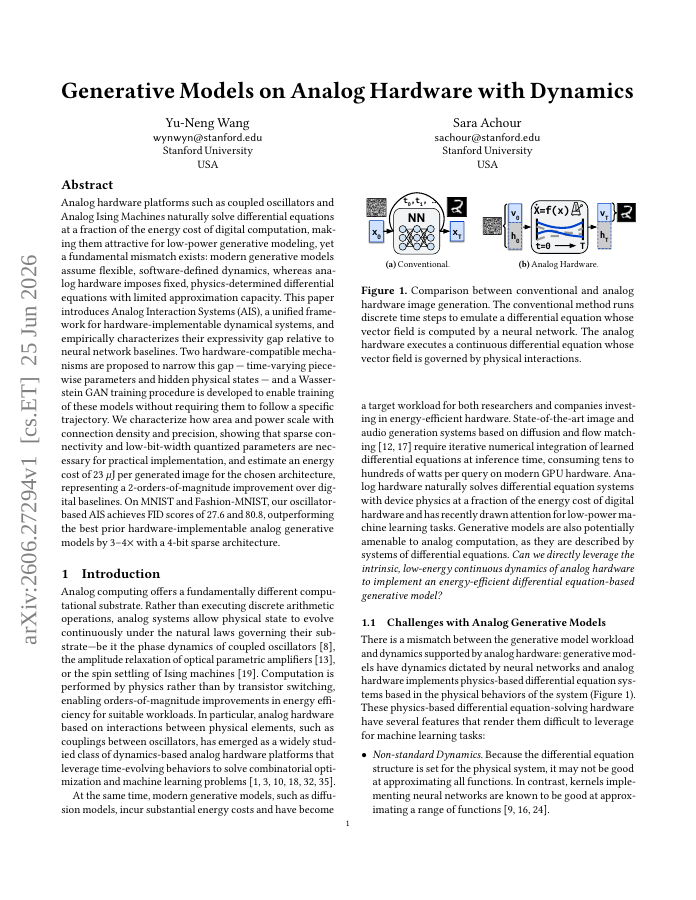
Analog hardware platforms such as coupled oscillators and Analog Ising Machines naturally solve differential equations at a fraction of the energy cost of digital computation, making them attractive for low-power generative modeling, yet a fundamental mismatch exists: modern generative models assume flexible, software-defined dynamics, whereas analog hardware imposes fixed, physics-determined differential equations with limited approximation capacity. This paper introduces Analog Interaction Systems (AIS), a unified framework for hardware-implementable dynamical systems, and empirically characterizes their expressivity gap relative to neural network baselines. Two hardware-compatible mechanisms are proposed to narrow this gap - time-varying piecewise parameters and hidden physical states - and a Wasserstein GAN training procedure is developed to enable training of these models without requiring them to follow a specific trajectory. We characterize how area and power scale with connection density and precision, showing that sparse connectivity and low-bit-width quantized parameters are necessary for practical implementation, and estimate an energy cost of 23uJ per generated image for the chosen architecture, representing a 2-orders-of-magnitude improvement over digital baselines. On MNIST and Fashion-MNIST, our oscillator-based AIS achieves FID scores of 27.6 and 80.8, outperforming the best prior hardware-implementable analog generative models by 3-4x with a 4-bit sparse architecture.
Generative Models on Analog Hardware with Dynamics
Analog hardware platforms such as coupled oscillators and Analog Ising Machines naturally solve differential equations at a fraction of the energy cost of digital computation, making them attractive for low-power generative modeling, yet a fundamental mismatch exists: modern…
- Preview
- Year
- 2026
- Hosting
- Full text hostedCC-BY-4.0
Cite
Notes
Only stored in your browser.
Attribution
- Abstract & full text
- arxiv.org/abs/2606.27294CC-BY-4.0
- TL;DR
- Semantic Scholar