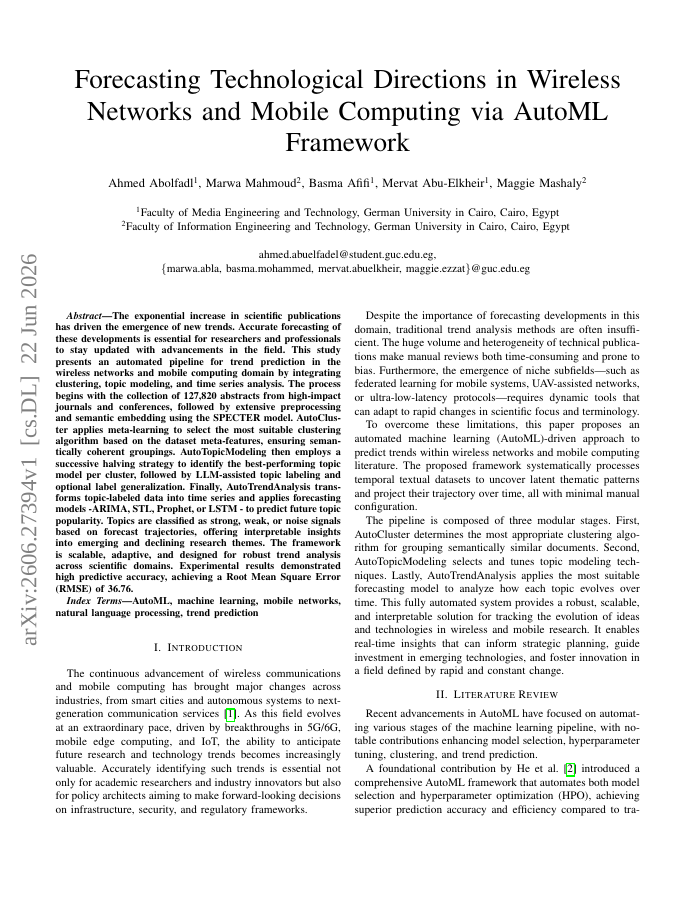
The exponential increase in scientific publications has driven the emergence of new trends. Accurate forecasting of these developments is essential for researchers and professionals to stay updated with advancements in the field. This study presents an automated pipeline for trend prediction in the wireless networks and mobile computing domain by integrating clustering, topic modeling, and time series analysis. The process begins with the collection of 127,820 abstracts from high-impact journals and conferences, followed by extensive preprocessing and semantic embedding using the SPECTER model. AutoCluster applies meta-learning to select the most suitable clustering algorithm based on the dataset meta-features, ensuring semantically coherent groupings. AutoTopicModeling then employs a successive halving strategy to identify the best-performing topic model per cluster, followed by LLM-assisted topic labeling and optional label generalization. Finally, AutoTrendAnalysis transforms topic-labeled data into time series and applies forecasting models -ARIMA, STL, Prophet, or LSTM - to predict future topic popularity. Topics are classified as strong, weak, or noise signals based on forecast trajectories, offering interpretable insights into emerging and declining research themes. The framework is scalable, adaptive, and designed for robust trend analysis across scientific domains. Experimental results demonstrated high predictive accuracy, achieving a Root Mean Square Error (RMSE) of 36.76.
Forecasting Technological Directions in Wireless Networks and Mobile Computing via AutoML Framework
The exponential increase in scientific publications has driven the emergence of new trends. Accurate forecasting of these developments is essential for researchers and professionals to stay updated with advancements in the field.
- Preview
- Year
- 2026
- Hosting
- Full text hostedCC-BY-4.0
Cite
Notes
Only stored in your browser.
Attribution
- Abstract & full text
- arxiv.org/abs/2606.27394CC-BY-4.0
- TL;DR
- Semantic Scholar