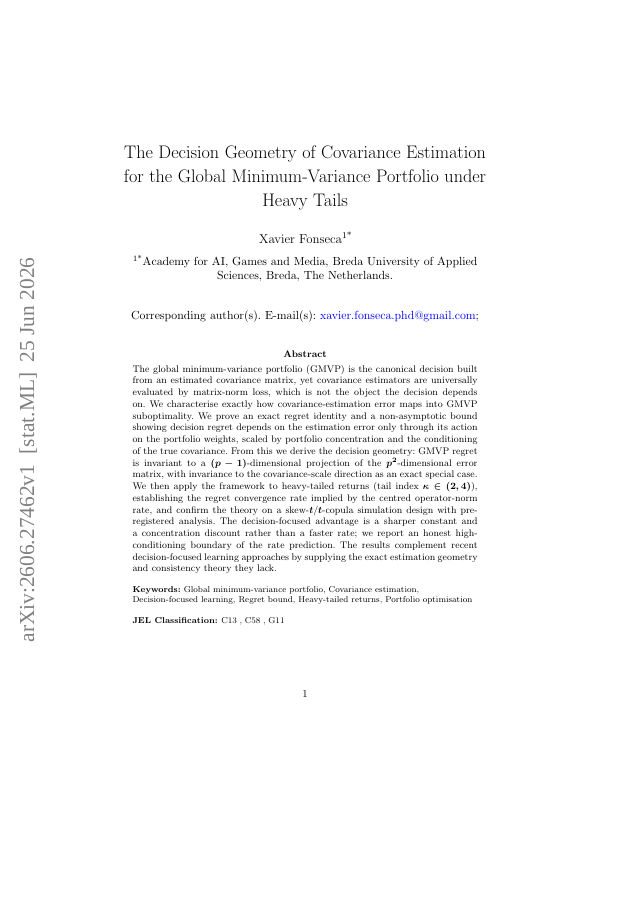
The global minimum-variance portfolio (GMVP) is the canonical decision built from an estimated covariance matrix, yet covariance estimators are universally evaluated by matrix-norm loss, which is not the object the decision depends on. We characterise exactly how covariance-estimation error maps into GMVP suboptimality. We prove an exact regret identity and a non-asymptotic bound showing decision regret depends on the estimation error only through its action on the portfolio weights, scaled by portfolio concentration and the conditioning of the true covariance. From this we derive the decision geometry: GMVP regret is invariant to a (p-1)-dimensional projection of the p^2-dimensional error matrix, with invariance to the covariance-scale direction as an exact special case. We then apply the framework to heavy-tailed returns (tail index kappa in (2,4)), establishing the regret convergence rate implied by the centred operator-norm rate, and confirm the theory on a skew-t/t-copula simulation design with pre-registered analysis. The decision-focused advantage is a sharper constant and a concentration discount rather than a faster rate; we report an honest high-conditioning boundary of the rate prediction. The results complement recent decision-focused learning approaches by supplying the exact estimation geometry and consistency theory they lack.
The Decision Geometry of Covariance Estimation for the Global Minimum-Variance Portfolio under Heavy Tails
The global minimum-variance portfolio (GMVP) is the canonical decision built from an estimated covariance matrix, yet covariance estimators are universally evaluated by matrix-norm loss, which is not the object the decision depends on.
- Preview
- Year
- 2026
- Hosting
- Abstract onlyARXIV-DEFAULT
Cite
Notes
Only stored in your browser.
Attribution
- Abstract & full text
- arxiv.org/abs/2606.27462ARXIV-DEFAULT
- TL;DR
- Semantic Scholar