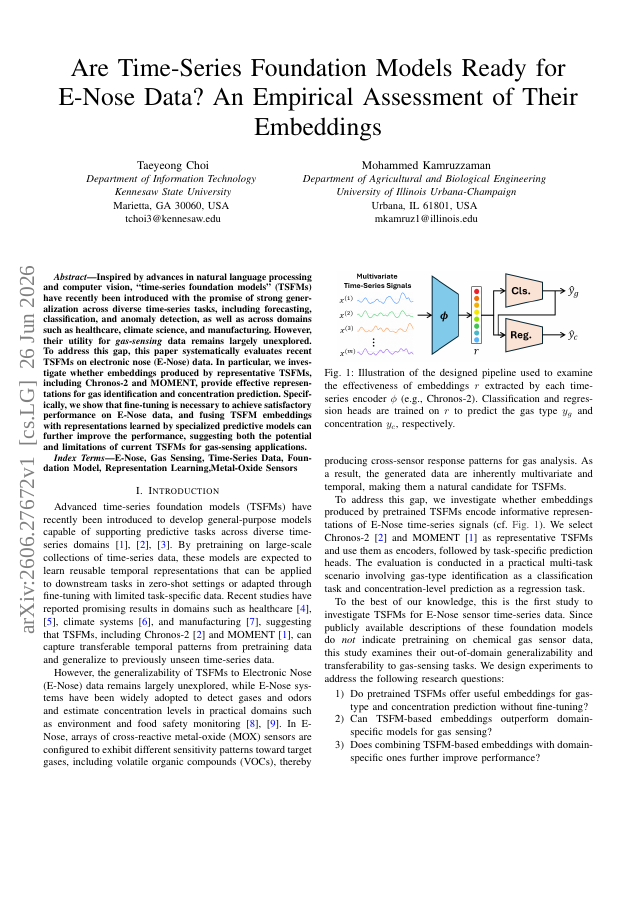
Inspired by advances in natural language processing and computer vision, "time-series foundation models" (TSFMs) have recently been introduced with the promise of strong generalization across diverse time-series tasks, including forecasting, classification, and anomaly detection, as well as across domains such as healthcare, climate science, and manufacturing. However, their utility for gas-sensing data remains largely unexplored. To address this gap, this paper systematically evaluates recent TSFMs on electronic nose (E-Nose) data. In particular, we investigate whether embeddings produced by representative TSFMs, including Chronos-2 and MOMENT, provide effective representations for gas identification and concentration prediction. Specifically, we show that fine-tuning is necessary to achieve satisfactory performance on E-Nose data, and fusing TSFM embeddings with representations learned by specialized predictive models can further improve the performance, suggesting both the potential and limitations of current TSFMs for gas-sensing applications.
Are Time-Series Foundation Models Ready for E-Nose Data? An Empirical Assessment of Their Embeddings
Inspired by advances in natural language processing and computer vision, "time-series foundation models" (TSFMs) have recently been introduced with the promise of strong generalization across diverse time-series tasks, including forecasting, classification, and anomaly…
- Preview
- Year
- 2026
- Hosting
- Abstract onlyARXIV-DEFAULT
Cite
Notes
Only stored in your browser.
Attribution
- Abstract & full text
- arxiv.org/abs/2606.27672ARXIV-DEFAULT
- TL;DR
- Semantic Scholar