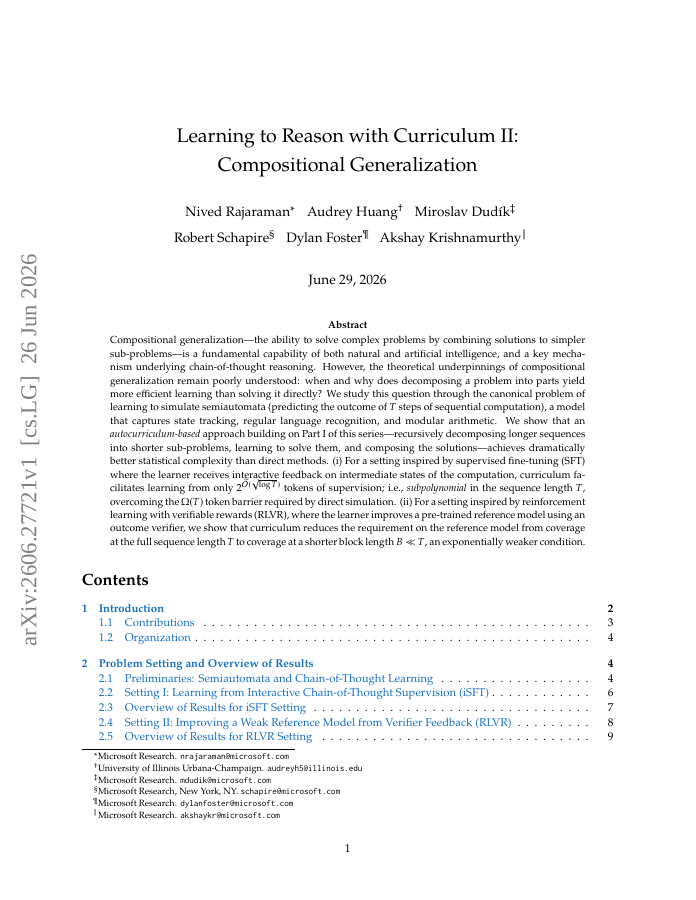
Compositional generalization, the ability to solve complex problems by combining solutions to simpler sub-problems, is a fundamental capability of both natural and artificial intelligence, and a key mechanism underlying chain-of-thought reasoning. However, the theoretical underpinnings of compositional generalization remain poorly understood: when and why does decomposing a problem into parts yield more efficient learning than solving it directly? We study this question through the canonical problem of learning to simulate semiautomata (predicting the outcome of T steps of sequential computation), a model that captures state tracking, regular language recognition, and modular arithmetic. We show that an autocurriculum-based approach building on Part I of this series, recursively decomposing longer sequences into shorter sub-problems, learning to solve them, and composing the solutions, achieves dramatically better statistical complexity than direct methods. (i) For a setting inspired by supervised fine-tuning (SFT) where the learner receives interactive feedback on intermediate states of the computation, curriculum facilitates learning from only 2^{O(\sqrt{\log T})} tokens of supervision; i.e., subpolynomial in the sequence length T, overcoming the Ω(T) token barrier required by direct simulation. (ii) For a setting inspired by reinforcement learning with verifiable rewards (RLVR), where the learner improves a pre-trained reference model using an outcome verifier, we show that curriculum reduces the requirement on the reference model from coverage at the full sequence length T to coverage at a shorter block length B \ll T, an exponentially weaker condition.
Learning to Reason with Curriculum II: Compositional Generalization
Compositional generalization, the ability to solve complex problems by combining solutions to simpler sub-problems, is a fundamental capability of both natural and artificial intelligence, and a key mechanism underlying chain-of-thought reasoning.
- Preview
- Year
- 2026
- Hosting
- Full text hostedCC-BY-4.0
Cite
Notes
Only stored in your browser.
Attribution
- Abstract & full text
- arxiv.org/abs/2606.27721CC-BY-4.0
- TL;DR
- Semantic Scholar