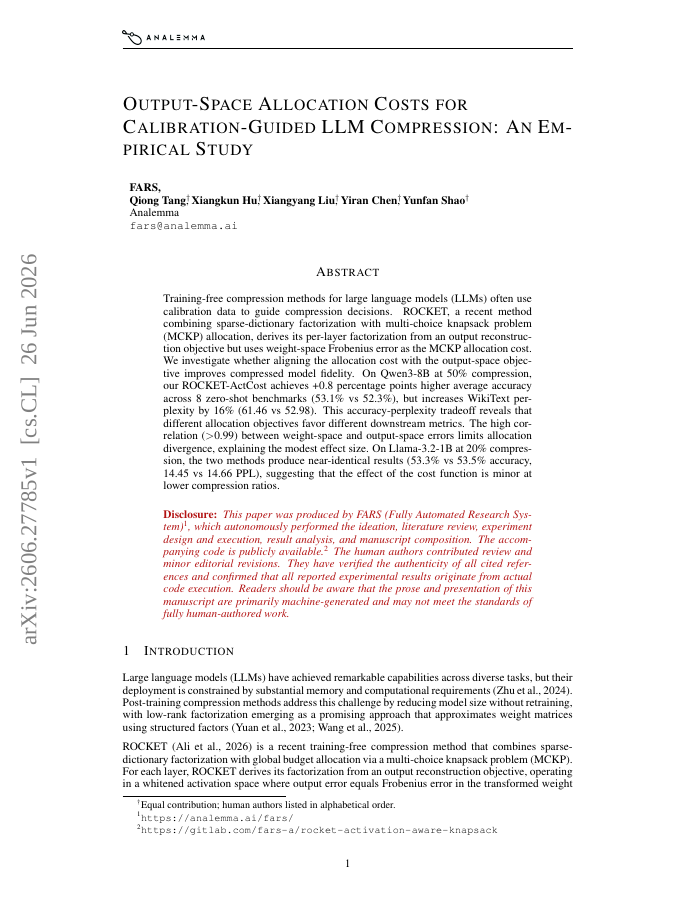
Training-free compression methods for large language models (LLMs) often use calibration data to guide compression decisions. ROCKET, a recent method combining sparse-dictionary factorization with multi-choice knapsack problem (MCKP) allocation, derives its per-layer factorization from an output reconstruction objective but uses weight-space Frobenius error as the MCKP allocation cost. We investigate whether aligning the allocation cost with the output-space objective improves compressed model fidelity. On Qwen3-8B at 50% compression, our ROCKET-ActCost achieves +0.8 percentage points higher average accuracy across 8 zero-shot benchmarks (53.1% vs 52.3%), but increases WikiText perplexity by 16% (61.46 vs 52.98). This accuracy-perplexity tradeoff reveals that different allocation objectives favor different downstream metrics. The high correlation (>0.99) between weight-space and output-space errors limits allocation divergence, explaining the modest effect size. On Llama-3.2-1B at 20% compression, the two methods produce near-identical results (53.3% vs 53.5% accuracy, 14.45 vs 14.66 PPL), suggesting that the effect of the cost function is minor at lower compression ratios.
Output-Space Allocation Costs for Calibration-Guided LLM Compression: An Empirical Study
Training-free compression methods for large language models (LLMs) often use calibration data to guide compression decisions. ROCKET, a recent method combining sparse-dictionary factorization with multi-choice knapsack problem (MCKP) allocation, derives its per-layer…
- Preview
- Year
- 2026
- Hosting
- Abstract onlyARXIV-DEFAULT
Cite
Notes
Only stored in your browser.
Attribution
- Abstract & full text
- arxiv.org/abs/2606.27785ARXIV-DEFAULT
- TL;DR
- Semantic Scholar