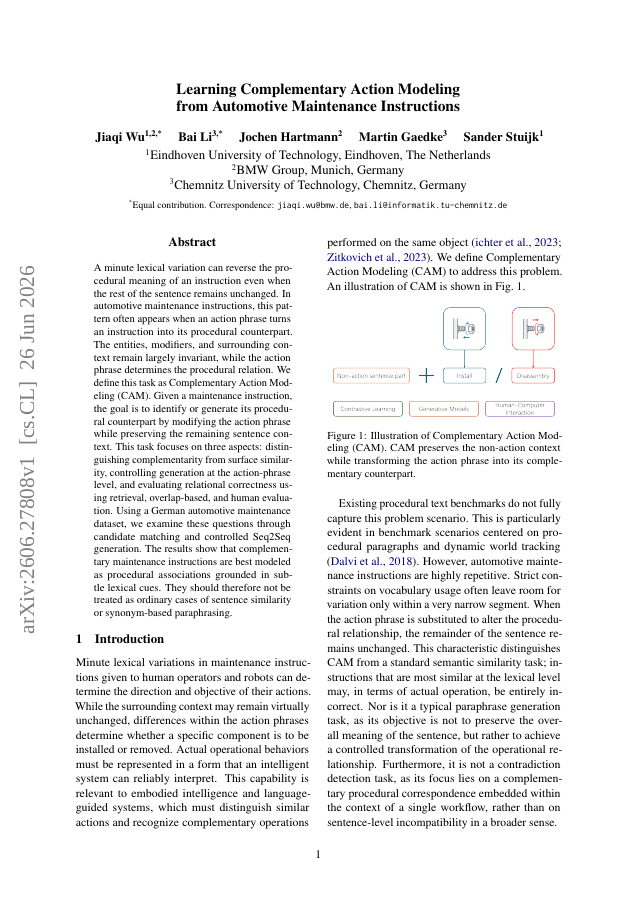
A minute lexical variation can reverse the procedural meaning of an instruction even when the rest of the sentence remains unchanged. In automotive maintenance instructions, this pattern often appears when an action phrase turns an instruction into its procedural counterpart. The entities, modifiers, and surrounding context remain largely invariant, while the action phrase determines the procedural relation. We define this task as Complementary Action Modeling (CAM). Given a maintenance instruction, the goal is to identify or generate its procedural counterpart by modifying the action phrase while preserving the remaining sentence context. This task focuses on three aspects: distinguishing complementarity from surface similarity, controlling generation at the action-phrase level, and evaluating relational correctness using retrieval, overlap-based, and human evaluation. Using a German automotive maintenance dataset, we examine these questions through candidate matching and controlled Seq2Seq generation. The results show that complementary maintenance instructions are best modeled as procedural associations grounded in subtle lexical cues. They should therefore not be treated as ordinary cases of sentence similarity or synonym-based paraphrasing.
Learning Complementary Action Modeling from Automotive Maintenance Instructions
A minute lexical variation can reverse the procedural meaning of an instruction even when the rest of the sentence remains unchanged. In automotive maintenance instructions, this pattern often appears when an action phrase turns an instruction into its procedural counterpart.
- Preview
- Year
- 2026
- Hosting
- Abstract onlyARXIV-DEFAULT
Cite
Notes
Only stored in your browser.
Attribution
- Abstract & full text
- arxiv.org/abs/2606.27808ARXIV-DEFAULT
- TL;DR
- Semantic Scholar