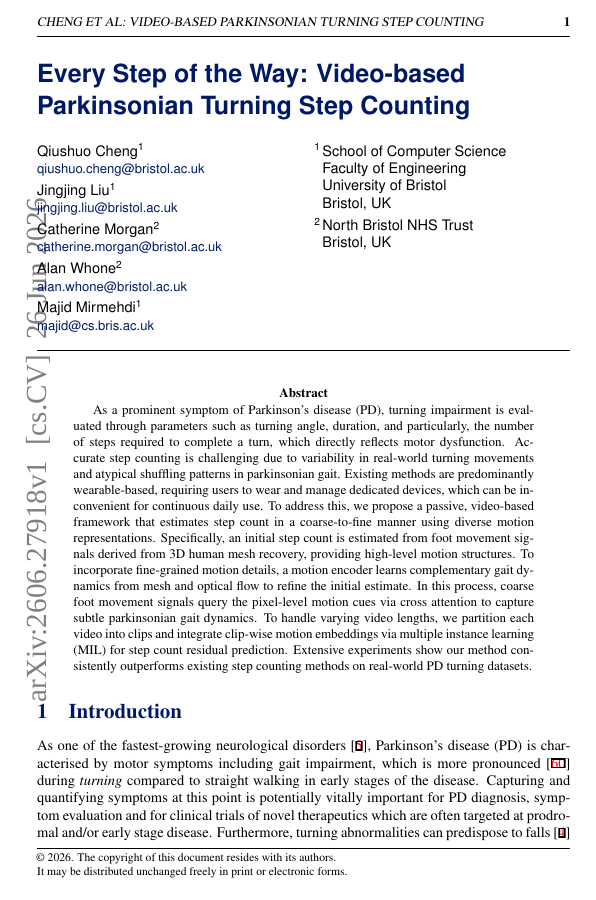
As a prominent symptom of Parkinson's disease (PD), turning impairment is evaluated through parameters such as turning angle, duration, and particularly, the number of steps required to complete a turn, which directly reflects motor dysfunction. Accurate step counting is challenging due to variability in real-world turning movements and atypical shuffling patterns in parkinsonian gait. Existing methods are predominantly wearable-based, requiring users to wear and manage dedicated devices, which can be inconvenient for continuous daily use. To address this, we propose a passive, video-based framework that estimates step count in a coarse-to-fine manner using diverse motion representations. Specifically, an initial step count is estimated from foot movement signals derived from 3D human mesh recovery, providing high-level motion structures. To incorporate fine-grained motion details, a motion encoder learns complementary gait dynamics from mesh and optical flow to refine the initial estimate. In this process, coarse foot movement signals query the pixel-level motion cues via cross attention to capture subtle parkinsonian gait dynamics. To handle varying video lengths, we partition each video into clips and integrate clip-wise motion embeddings via multiple instance learning (MIL) for step count residual prediction. Extensive experiments show our method consistently outperforms existing step counting methods on real-world PD turning datasets.
Every Step of the Way: Video-based Parkinsonian Turning Step Counting
As a prominent symptom of Parkinson's disease (PD), turning impairment is evaluated through parameters such as turning angle, duration, and particularly, the number of steps required to complete a turn, which directly reflects motor dysfunction.
- Preview
- Year
- 2026
- Hosting
- Excerpt onlyCC-BY-NC-4.0
Cite
Notes
Only stored in your browser.
Attribution
- Abstract & full text
- arxiv.org/abs/2606.27918CC-BY-NC-4.0
- TL;DR
- Semantic Scholar