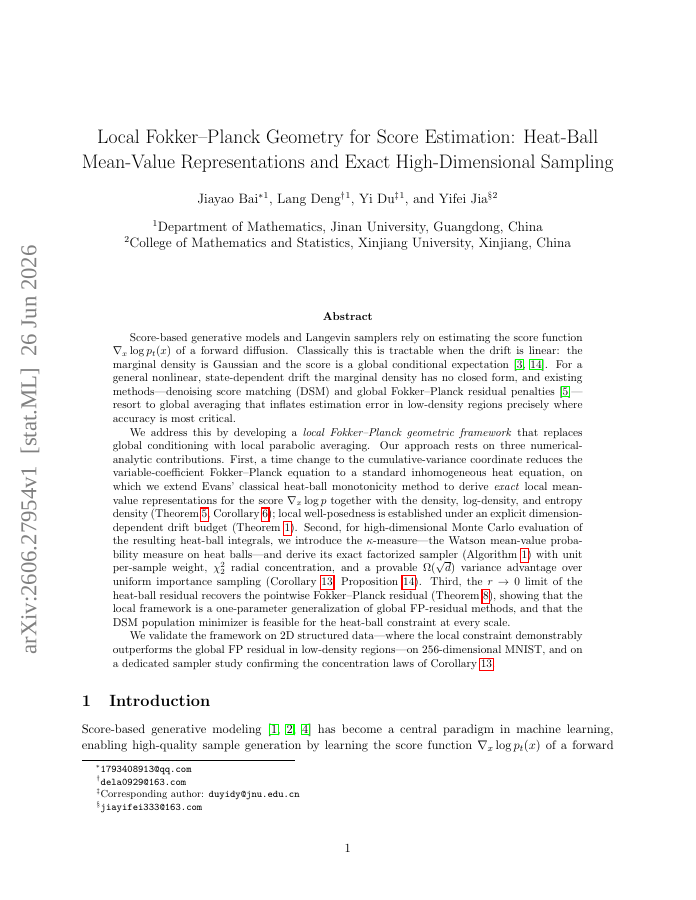
Score-based generative models and Langevin samplers rely on estimating the score function \nabla_x\log p_t(x) of a forward diffusion. Classically this is tractable when the drift is linear: the marginal density is Gaussian and the score is a global conditional expectation. For a general nonlinear, state-dependent drift the marginal density has no closed form, and existing methods--denoising score matching and global Fokker--Planck residual penalties--resort to global averaging that inflates estimation error in low-density regions precisely where accuracy is most critical. We address this by developing a local Fokker--Planck geometric framework that replaces global conditioning with local parabolic averaging. Our approach rests on three contributions. First, a time change to the cumulative-variance coordinate reduces the variable-coefficient Fokker--Planck equation to a standard inhomogeneous heat equation, on which we extend Evans' classical heat-ball monotonicity method to derive exact local mean-value representations for the score \nabla_x\log p together with the density, log-density, and entropy density; local well-posedness is established under an explicit dimension-dependent drift budget. Second, for high-dimensional Monte Carlo evaluation of the resulting heat-ball integrals, we introduce the κ-measure and derive its exact factorized sampler with unit per-sample weight, χ^2_2 radial concentration. Third, the r\to0 limit of the heat-ball residual recovers the pointwise Fokker--Planck residual, showing that the local framework is a one-parameter generalization of global FP-residual methods, and that the DSM population minimizer is feasible for the heat-ball constraint at every scale. We validate the framework on 2D structured data on 256-dimensional MNIST, and on a dedicated sampler study confirming the concentration laws.
Local Fokker--Planck Geometry for Score Estimation: Heat-Ball Mean-Value Representations and Exact High-Dimensional Sampling
Score-based generative models and Langevin samplers rely on estimating the score function $\nabla_x\log p_t(x)$ of a forward diffusion. Classically this is tractable when the drift is linear: the marginal density is Gaussian and the score is a global conditional expectation.
- Preview
- Year
- 2026
- Hosting
- Abstract onlyARXIV-DEFAULT
Cite
Notes
Only stored in your browser.
Attribution
- Abstract & full text
- arxiv.org/abs/2606.27954ARXIV-DEFAULT
- TL;DR
- Semantic Scholar