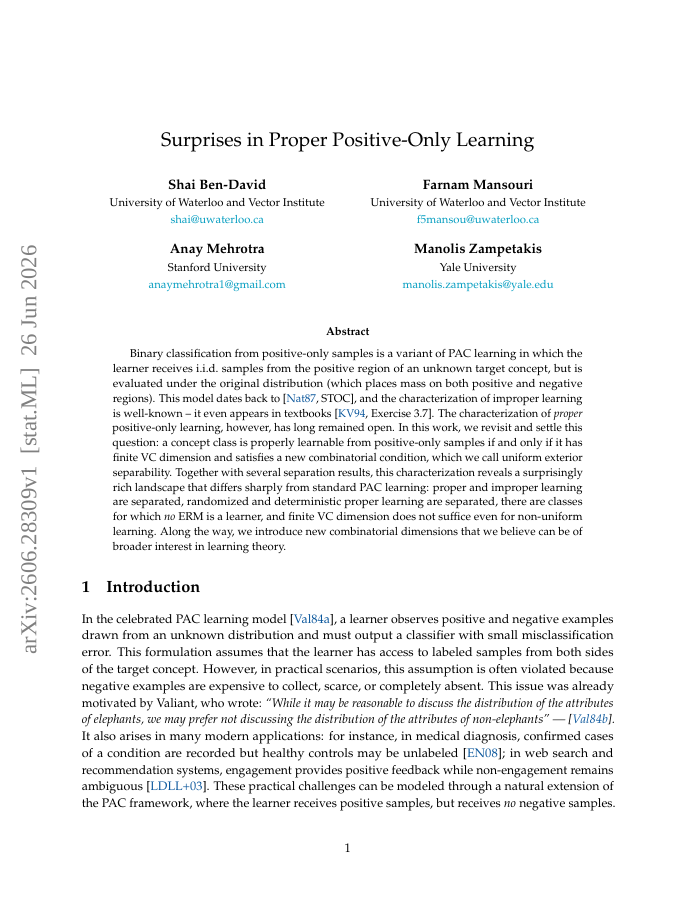
Binary classification from positive-only samples is a variant of PAC learning in which the learner receives i.i.d. samples from the positive region of an unknown target concept, but is evaluated under the original distribution (which places mass on both positive and negative regions). This model dates back to Natarajan [1987, STOC], and the characterization of improper learning is well-known -- it even appears in textbooks. The characterization of proper positive-only learning, however, has long remained open. In this work, we revisit and settle this question: a concept class is properly learnable from positive-only samples if and only if it has finite VC dimension and satisfies a new combinatorial condition, which we call uniform exterior separability. Together with several separation results, this characterization reveals a surprisingly rich landscape that differs sharply from standard PAC learning: proper and improper learning are separated, randomized and deterministic proper learning are separated, there are classes for which no ERM is a learner, and finite VC dimension does not suffice even for non-uniform learning. Along the way, we introduce new combinatorial dimensions that we believe can be of broader interest in learning theory.
Surprises in Proper Positive-Only Learning
Binary classification from positive-only samples is a variant of PAC learning in which the learner receives i.i.d. samples from the positive region of an unknown target concept, but is evaluated under the original distribution (which places mass on both positive and negative…
- Preview
- Year
- 2026
- Hosting
- Abstract onlyARXIV-DEFAULT
Cite
Notes
Only stored in your browser.
Attribution
- Abstract & full text
- arxiv.org/abs/2606.28309ARXIV-DEFAULT
- TL;DR
- Semantic Scholar