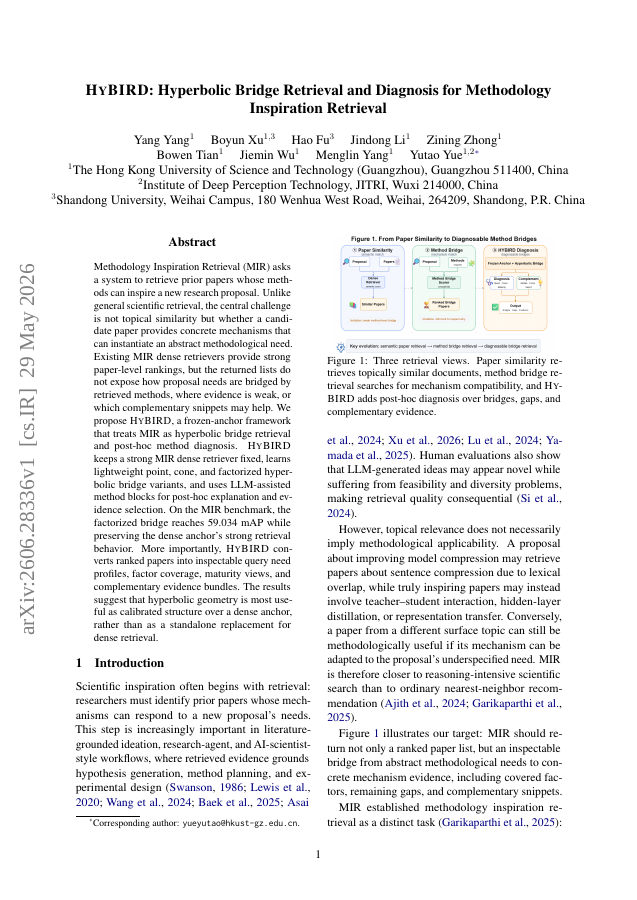
Methodology Inspiration Retrieval (MIR) asks a system to retrieve prior papers whose methods can inspire a new research proposal. Unlike general scientific retrieval, the central challenge is not topical similarity but whether a candidate paper provides concrete mechanisms that can instantiate an abstract methodological need. Existing MIR dense retrievers provide strong paper-level rankings, but the returned lists do not expose how proposal needs are bridged by retrieved methods, where evidence is weak, or which complementary snippets may help. We propose HyBIRD, a frozen-anchor framework that treats MIR as hyperbolic bridge retrieval and post-hoc method diagnosis. HyBIRD keeps a strong MIR dense retriever fixed, learns lightweight point, cone, and factorized hyperbolic bridge variants, and uses LLM-assisted method blocks for post-hoc explanation and evidence selection. On the MIR benchmark, the factorized bridge reaches 59.034 mAP while preserving the dense anchor's strong retrieval behavior. More importantly, HyBIRD converts ranked papers into inspectable query need profiles, factor coverage, maturity views, and complementary evidence bundles. The results suggest that hyperbolic geometry is most useful as calibrated structure over a dense anchor, rather than as a standalone replacement for dense retrieval.
HyBIRD: Hyperbolic Bridge Retrieval and Diagnosis for Methodology Inspiration Retrieval
Methodology Inspiration Retrieval (MIR) asks a system to retrieve prior papers whose methods can inspire a new research proposal. Unlike general scientific retrieval, the central challenge is not topical similarity but whether a candidate paper provides concrete mechanisms that…
- Preview
- Year
- 2026
- Hosting
- Abstract onlyARXIV-DEFAULT
Cite
Notes
Only stored in your browser.
Attribution
- Abstract & full text
- arxiv.org/abs/2606.28336ARXIV-DEFAULT
- TL;DR
- Semantic Scholar