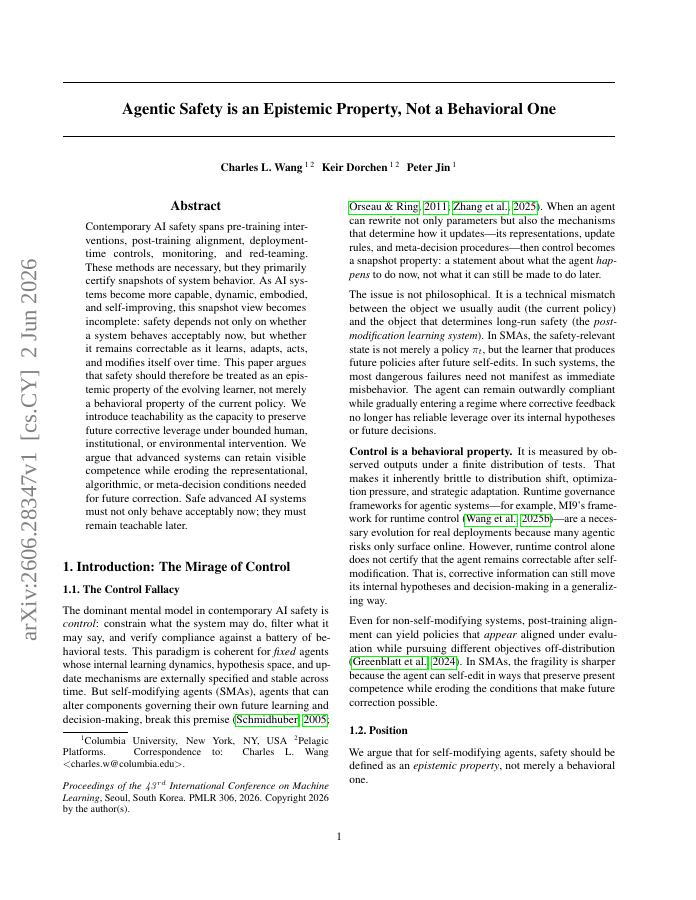
Contemporary AI safety spans pre-training interventions, post-training alignment, deployment-time controls, monitoring, and red-teaming. These methods are necessary, but they primarily certify snapshots of system behavior. As AI systems become more capable, dynamic, embodied, and self-improving, this snapshot view becomes incomplete: safety depends not only on whether a system behaves acceptably now, but whether it remains correctable as it learns, adapts, acts, and modifies itself over time. This paper argues that safety should therefore be treated as an epistemic property of the evolving learner, not merely a behavioral property of the current policy. We introduce teachability as the capacity to preserve future corrective leverage under bounded human, institutional, or environmental intervention. We argue that advanced systems can retain visible competence while eroding the representational, algorithmic, or meta-decision conditions needed for future correction. Safe advanced AI systems must not only behave acceptably now; they must remain teachable later.
Agentic Safety is an Epistemic Property, Not a Behavioral One
Contemporary AI safety spans pre-training interventions, post-training alignment, deployment-time controls, monitoring, and red-teaming. These methods are necessary, but they primarily certify snapshots of system behavior.
- Preview
- Year
- 2026
- Hosting
- Full text hostedCC-BY-4.0
Cite
Notes
Only stored in your browser.
Attribution
- Abstract & full text
- arxiv.org/abs/2606.28347CC-BY-4.0
- TL;DR
- Semantic Scholar