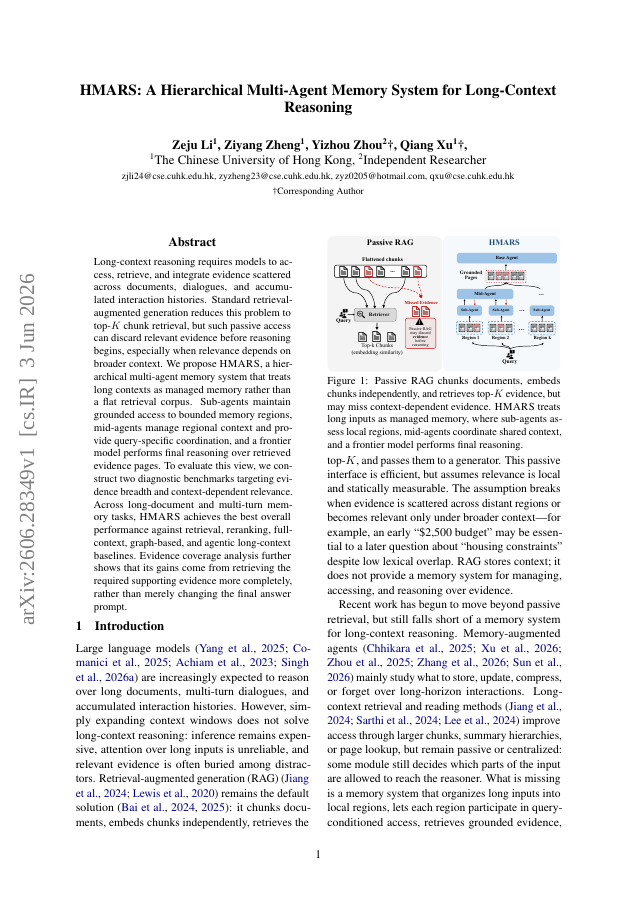
Long-context reasoning requires models to access, retrieve, and integrate evidence scattered across documents, dialogues, and accumulated interaction histories. Standard retrieval-augmented generation reduces this problem to top-K chunk retrieval, but such passive access can discard relevant evidence before reasoning begins, especially when relevance depends on broader context. We propose HMARS, a hierarchical multi-agent memory system that treats long contexts as managed memory rather than a flat retrieval corpus. Sub-agents maintain grounded access to bounded memory regions, mid-agents manage regional context and provide query-specific coordination, and a frontier model performs final reasoning over retrieved evidence pages. To evaluate this view, we construct two diagnostic benchmarks targeting evidence breadth and context-dependent relevance. Across long-document and multi-turn memory tasks, HMARS achieves the best overall performance against retrieval, reranking, full-context, graph-based, and agentic long-context baselines. Evidence coverage analysis further shows that its gains come from retrieving the required supporting evidence more completely, rather than merely changing the final answer prompt.
HMARS: A Hierarchical Multi-Agent Memory System for Long-Context Reasoning
Long-context reasoning requires models to access, retrieve, and integrate evidence scattered across documents, dialogues, and accumulated interaction histories. Standard retrieval-augmented generation reduces this problem to top-$K$ chunk retrieval, but such passive access can…
- Preview
- Year
- 2026
- Hosting
- Full text hostedCC-BY-4.0
Cite
Notes
Only stored in your browser.
Attribution
- Abstract & full text
- arxiv.org/abs/2606.28349CC-BY-4.0
- TL;DR
- Semantic Scholar