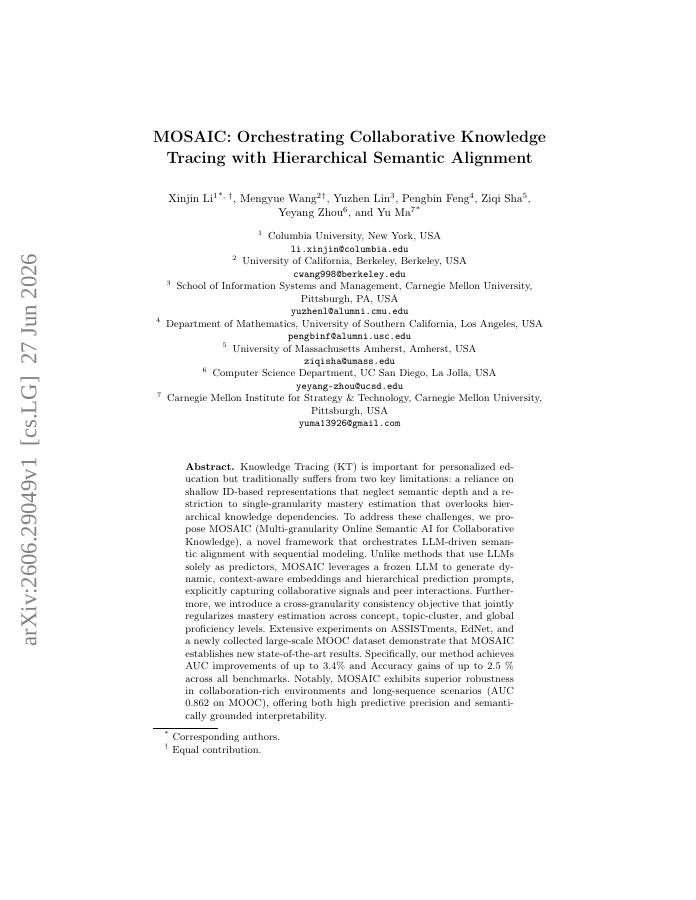
Knowledge Tracing (KT) is important for personalized education but traditionally suffers from two key limitations: a reliance on shallow ID-based representations that neglect semantic depth and a restriction to single-granularity mastery estimation that overlooks hierarchical knowledge dependencies. To address these challenges, we propose MOSAIC (Multi-granularity Online Semantic AI for Collaborative Knowledge), a novel framework that orchestrates LLM-driven semantic alignment with sequential modeling. Unlike methods that use LLMs solely as predictors, MOSAIC leverages a frozen LLM to generate dynamic, context-aware embeddings and hierarchical prediction prompts, explicitly capturing collaborative signals and peer interactions. Furthermore, we introduce a cross-granularity consistency objective that jointly regularizes mastery estimation across concept, topic-cluster, and global proficiency levels. Extensive experiments on ASSISTments, EdNet, and a newly collected large-scale MOOC dataset demonstrate that MOSAIC establishes new state-of-the-art results. Specifically, our method achieves AUC improvements of up to 3.4% and Accuracy gains of up to 2.5 % across all benchmarks. Notably, MOSAIC exhibits superior robustness in collaboration-rich environments and long-sequence scenarios (AUC 0.862 on MOOC), offering both high predictive precision and semantically grounded interpretability.
MOSAIC: Orchestrating Collaborative Knowledge Tracing with Hierarchical Semantic Alignment
Knowledge Tracing (KT) is important for personalized education but traditionally suffers from two key limitations: a reliance on shallow ID-based representations that neglect semantic depth and a restriction to single-granularity mastery estimation that overlooks hierarchical…
- Preview
- Year
- 2026
- Hosting
- Abstract onlyARXIV-DEFAULT
Cite
Notes
Only stored in your browser.
Attribution
- Abstract & full text
- arxiv.org/abs/2606.29049ARXIV-DEFAULT
- TL;DR
- Semantic Scholar