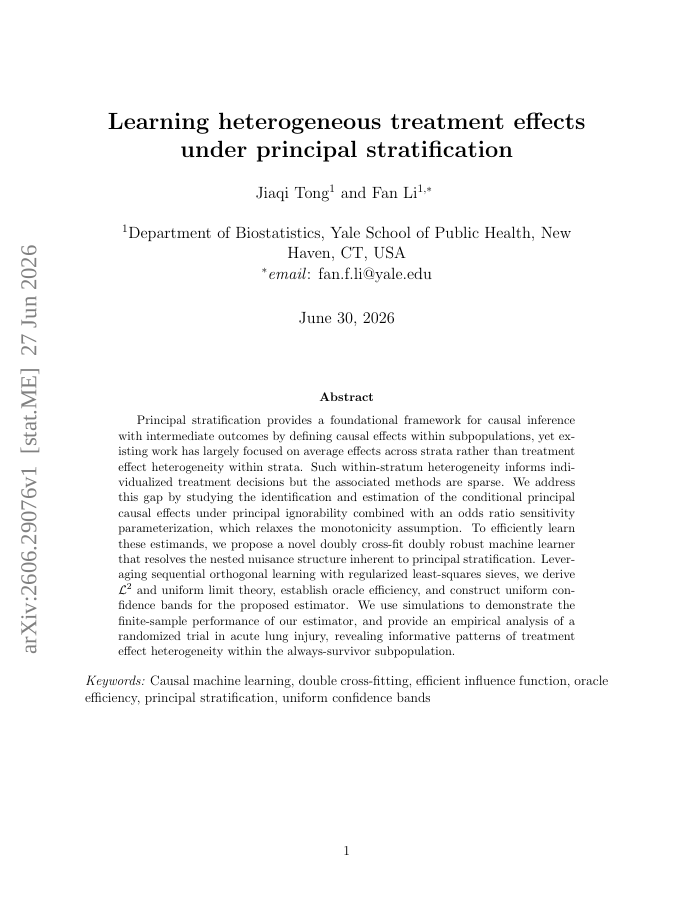
Principal stratification provides a foundational framework for causal inference with intermediate outcomes by defining causal effects within subpopulations, yet existing work has largely focused on average effects across strata rather than treatment effect heterogeneity within strata. Such within-stratum heterogeneity informs individualized treatment decisions but the associated methods are sparse. We address this gap by studying the identification and estimation of the conditional principal causal effects under principal ignorability combined with an odds ratio sensitivity parameterization, which relaxes the monotonicity assumption. To efficiently learn these estimands, we propose a novel doubly cross-fit doubly robust machine learner that resolves the nested nuisance structure inherent to principal stratification. Leveraging sequential orthogonal learning with regularized least-squares sieves, we derive L^2 and uniform limit theory, establish oracle efficiency, and construct uniform confidence bands for the proposed estimator. We use simulations to demonstrate the finite-sample performance of our estimator, and provide an empirical analysis of a randomized trial in acute lung injury, revealing informative patterns of treatment effect heterogeneity within the always-survivor subpopulation.
Learning heterogeneous treatment effects under principal stratification
Principal stratification provides a foundational framework for causal inference with intermediate outcomes by defining causal effects within subpopulations, yet existing work has largely focused on average effects across strata rather than treatment effect heterogeneity within…
- Preview
- Year
- 2026
- Hosting
- Excerpt onlyCC-BY-NC-SA-4.0
Cite
Notes
Only stored in your browser.
Attribution
- Abstract & full text
- arxiv.org/abs/2606.29076CC-BY-NC-SA-4.0
- TL;DR
- Semantic Scholar