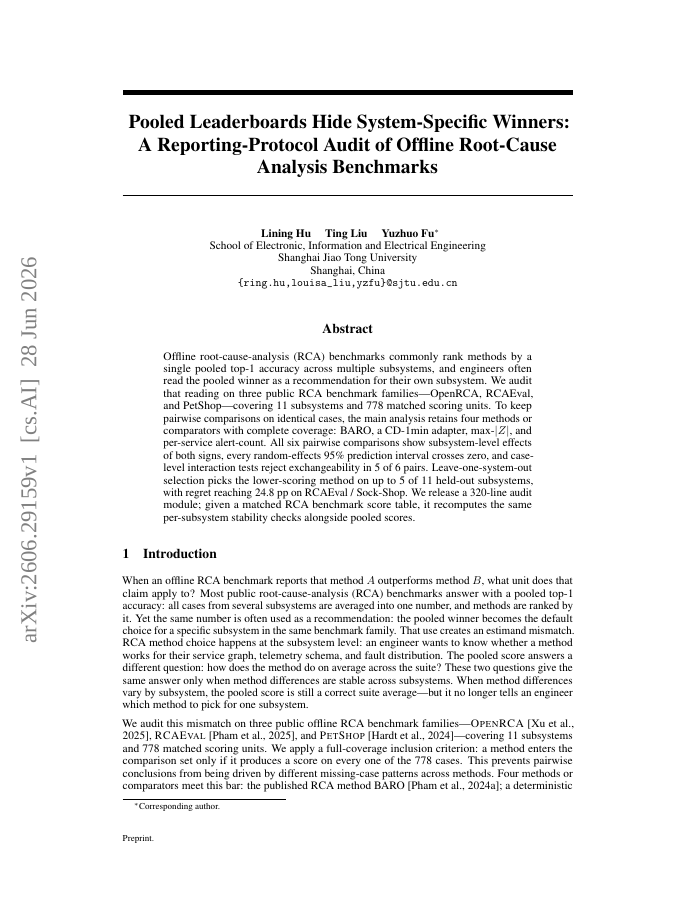
Offline root-cause-analysis (RCA) benchmarks commonly rank methods by a single pooled top-1 accuracy across multiple subsystems, and engineers often read the pooled winner as a recommendation for their own subsystem. We audit that reading on three public RCA benchmark families -- OpenRCA, RCAEval, and PetShop -- covering 11 subsystems and 778 matched scoring units. To keep pairwise comparisons on identical cases, the main analysis retains four methods or comparators with complete coverage: BARO, a CD-1min adapter, max-|Z|, and per-service alert-count. All six pairwise comparisons show subsystem-level effects of both signs, every random-effects 95% prediction interval crosses zero, and case-level interaction tests reject exchangeability in 5 of 6 pairs. Leave-one-system-out selection picks the lower-scoring method on up to 5 of 11 held-out subsystems, with regret reaching 24.8 pp on RCAEval / Sock-Shop. We release a 320-line audit module; given a matched RCA benchmark score table, it recomputes the same per-subsystem stability checks alongside pooled scores.
Pooled Leaderboards Hide System-Specific Winners: A Reporting-Protocol Audit of Offline Root-Cause Analysis Benchmarks
Offline root-cause-analysis (RCA) benchmarks commonly rank methods by a single pooled top-1 accuracy across multiple subsystems, and engineers often read the pooled winner as a recommendation for their own subsystem.
- Preview
- Year
- 2026
- Hosting
- Full text hostedCC-BY-4.0
Cite
Notes
Only stored in your browser.
Attribution
- Abstract & full text
- arxiv.org/abs/2606.29159CC-BY-4.0
- TL;DR
- Semantic Scholar