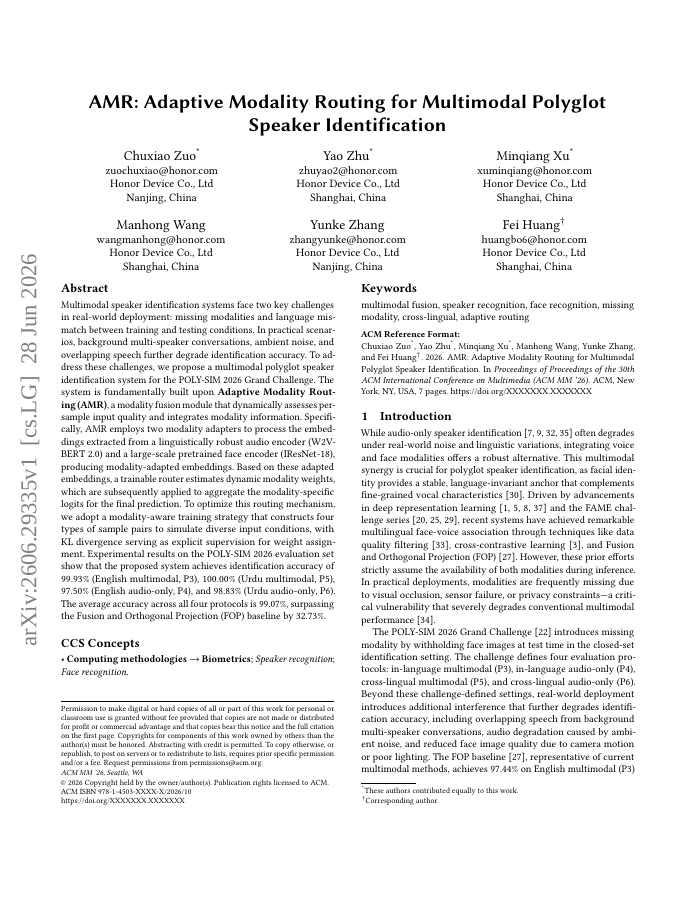
Multimodal speaker identification systems face two key challenges in real-world deployment: missing modalities and language mismatch between training and testing conditions. In practical scenarios, background multi-speaker conversations, ambient noise, and overlapping speech further degrade identification accuracy. To address these challenges, we propose a multimodal polyglot speaker identification system for the POLY-SIM 2026 Grand Challenge. The system is fundamentally built upon Adaptive Modality Routing(AMR), a modality fusion module that dynamically assesses per-sample input quality and integrates modality information. Specifically, AMR employs two modality adapters to process the embeddings extracted from a linguistically robust audio encoder(W2V-BERT 2.0) and a large-scale pretrained face encoder(IResNet-18), producing modality-adapted embeddings. Based on these adapted embeddings, a trainable router estimates dynamic modality weights, which are subsequently applied to aggregate the modality-specific logits for the final prediction. To optimize this routing mechanism, we adopt a modality-aware training strategy that constructs four types of sample pairs to simulate diverse input conditions, with KL divergence serving as explicit supervision for weight assignment. Experimental results on the POLY-SIM 2026 evaluation set show that the proposed system achieves identification accuracy of 99.93%(English multimodal, P3), 100.00%(Urdu multimodal, P5), 97.50%(English audio-only, P4), and 98.83%(Urdu audio-only, P6). The average accuracy across all four protocols is 99.07%, surpassing the Fusion and Orthogonal Projection(FOP) baseline by 32.73%.
AMR: Adaptive Modality Routing for Multimodal Polyglot Speaker Identification
Multimodal speaker identification systems face two key challenges in real-world deployment: missing modalities and language mismatch between training and testing conditions.
- Preview
- Year
- 2026
- Hosting
- Abstract onlyARXIV-DEFAULT
Cite
Notes
Only stored in your browser.
Attribution
- Abstract & full text
- arxiv.org/abs/2606.29335ARXIV-DEFAULT
- TL;DR
- Semantic Scholar