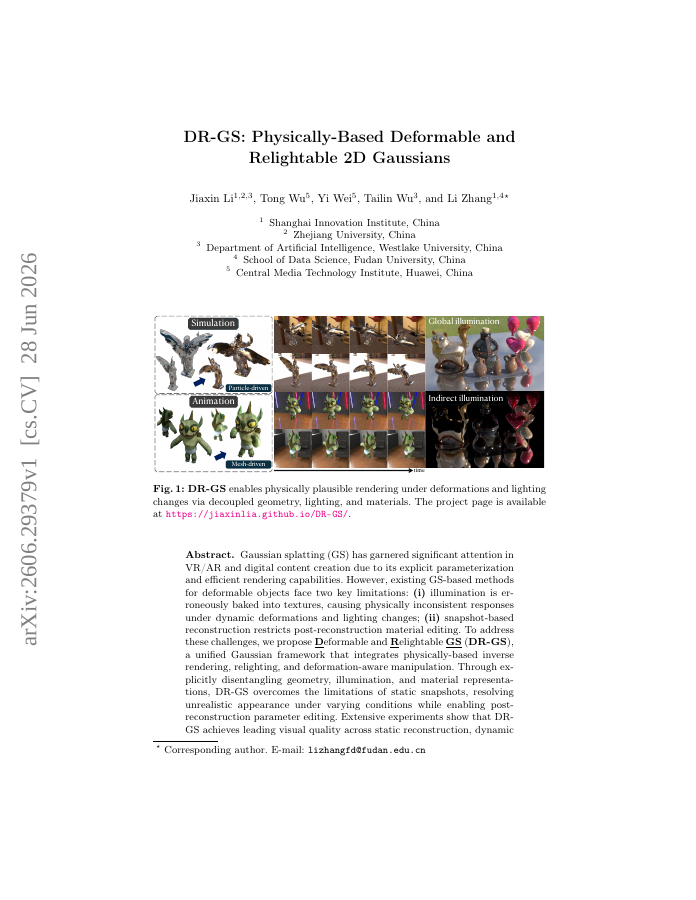
Gaussian splatting (GS) has garnered significant attention in VR/AR and digital content creation due to its explicit parameterization and efficient rendering capabilities. However, existing GS-based methods for deformable objects face two key limitations: (i) illumination is erroneously baked into textures, causing physically inconsistent responses under dynamic deformations and lighting changes; (ii) snapshot-based reconstruction restricts post-reconstruction material editing. To address these challenges, we propose Deformable and Relightable GS (DR-GS), a unified Gaussian framework that integrates physically-based inverse rendering, relighting, and deformation-aware manipulation. Through explicitly disentangling geometry, illumination, and material representations, DR-GS overcomes the limitations of static snapshots, resolving unrealistic appearance under varying conditions while enabling post-reconstruction parameter editing. Extensive experiments show that DR-GS achieves leading visual quality across static reconstruction, dynamic deformation, and relighting, reliably preserving reflections and specular highlights on glossy surfaces. It further establishes a fully decoupled geometry-illumination-material pipeline, enabling high-quality 3D asset creation and comprehensive post-editing.
DR-GS: Physically-Based Deformable and Relightable 2D Gaussians
Gaussian splatting (GS) has garnered significant attention in VR/AR and digital content creation due to its explicit parameterization and efficient rendering capabilities.
- Preview
- Year
- 2026
- Hosting
- Abstract onlyARXIV-DEFAULT
Cite
Notes
Only stored in your browser.
Attribution
- Abstract & full text
- arxiv.org/abs/2606.29379ARXIV-DEFAULT
- TL;DR
- Semantic Scholar