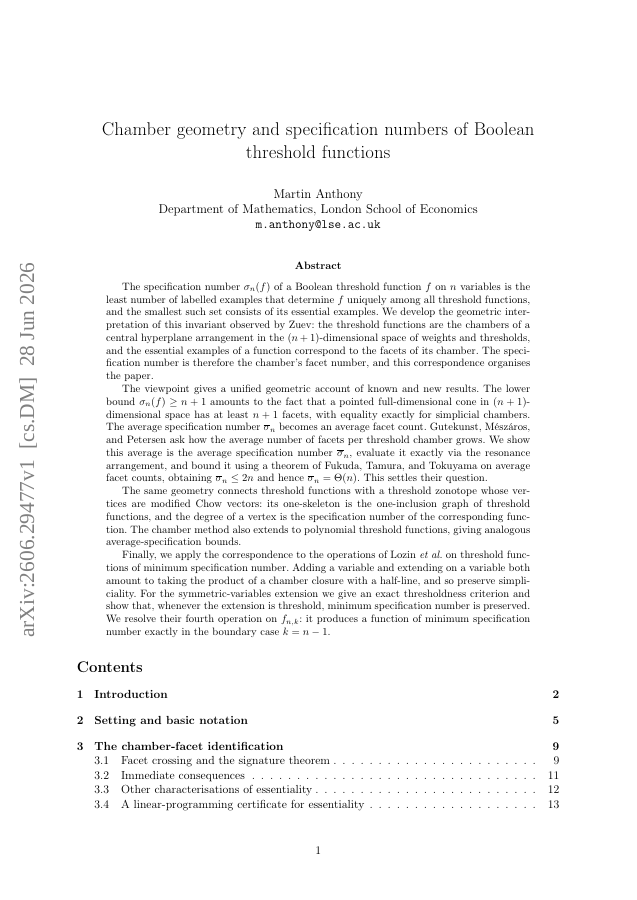
The specification number σ_n(f) of a Boolean threshold function f on n variables is the least number of points whose f-values determine f uniquely among all threshold functions. Its essential points form the unique minimum such set. We develop Zuev's geometric interpretation: the threshold functions are the chambers of a central hyperplane arrangement in the (n+1)-dimensional space of weights and thresholds, and the essential points of a function correspond exactly to the facets of its chamber, so the specification number is the chamber's facet number. The lower bound σ_n(f)\ge n+1 becomes the fact that a pointed full-dimensional cone has at least n+1 facets, with equality for simplicial chambers. The average specification number \overlineσ_n becomes an average facet count. We evaluate this average exactly via the resonance arrangement and bound it through a theorem of Fukuda, Tamura, and Tokuyama, obtaining \overlineσ_n\le 2n; hence \overlineσ_n=Θ(n). This settles a question of Gutekunst, Mészáros, and Petersen. The method also extends to polynomial threshold functions. The same geometry links threshold functions with a threshold zonotope, whose vertices are modified Chow vectors. Its one-skeleton is the one-inclusion graph, and a vertex's degree is the specification number of that function. Finally, we treat the operations of Lozin et al. on functions of minimum specification number. Adding a variable and extending on a variable both take the product of a chamber closure with a half-line, preserving simpliciality. For the symmetric-variables extension we give an exact thresholdness criterion and show that minimum specification number is preserved whenever the extension is a threshold function. We also resolve a question they pose concerning a fourth operation.
Chamber geometry and specification numbers of Boolean threshold functions
The specification number $σ_n(f)$ of a Boolean threshold function $f$ on $n$ variables is the least number of points whose $f$-values determine $f$ uniquely among all threshold functions. Its essential points form the unique minimum such set.
- Preview
- Year
- 2026
- Hosting
- Abstract onlyARXIV-DEFAULT
Cite
Notes
Only stored in your browser.
Attribution
- Abstract & full text
- arxiv.org/abs/2606.29477ARXIV-DEFAULT
- TL;DR
- Semantic Scholar