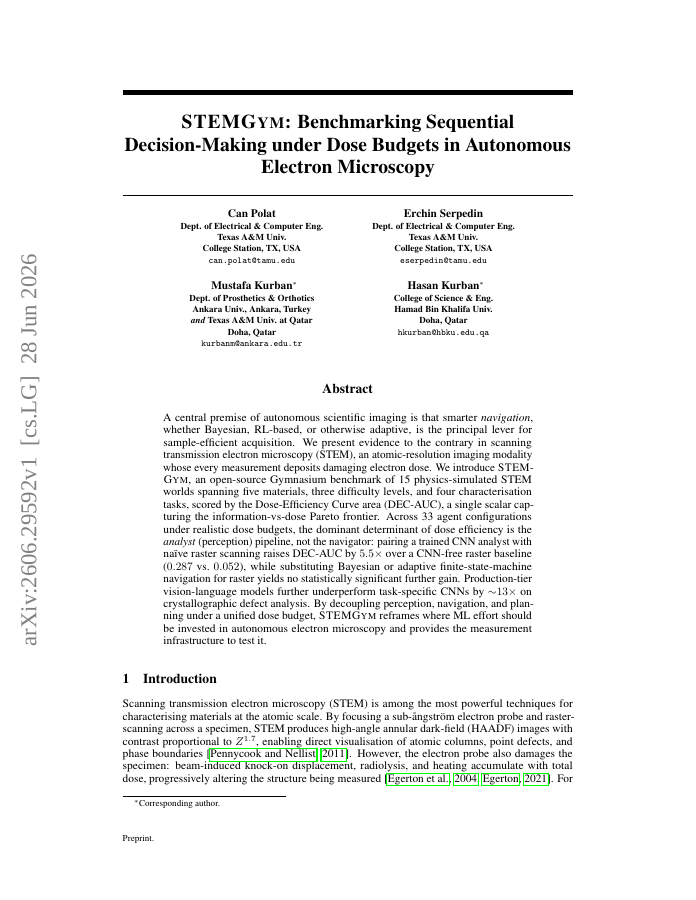
A central premise of autonomous scientific imaging is that smarter navigation, whether Bayesian, RL-based, or otherwise adaptive, is the principal lever for sample-efficient acquisition. We present evidence to the contrary in scanning transmission electron microscopy (STEM), an atomic-resolution imaging modality whose every measurement deposits damaging electron dose. We introduce STEMGym, an open-source Gymnasium benchmark of 15 physics-simulated STEM worlds spanning five materials, three difficulty levels, and four characterisation tasks, scored by the Dose-Efficiency Curve area (DEC-AUC), a single scalar capturing the information-vs-dose Pareto frontier. Across 33 agent configurations under realistic dose budgets, the dominant determinant of dose efficiency is the analyst (perception) pipeline, not the navigator: pairing a trained CNN analyst with naïve raster scanning raises DEC-AUC by 5.5x over a CNN-free raster baseline (0.287 vs.\ 0.052), while substituting Bayesian or adaptive finite-state-machine navigation for raster yields no statistically significant further gain. Production-tier vision-language models further underperform task-specific CNNs by {\sim}13x on crystallographic defect analysis. By decoupling perception, navigation, and planning under a unified dose budget, STEMGym reframes where ML effort should be invested in autonomous electron microscopy and provides the measurement infrastructure to test it.
STEMGym: Benchmarking Sequential Decision-Making under Dose Budgets in Autonomous Electron Microscopy
A central premise of autonomous scientific imaging is that smarter navigation, whether Bayesian, RL-based, or otherwise adaptive, is the principal lever for sample-efficient acquisition.
- Preview
- Year
- 2026
- Hosting
- Full text hostedCC-BY-4.0
Cite
Notes
Only stored in your browser.
Attribution
- Abstract & full text
- arxiv.org/abs/2606.29592CC-BY-4.0
- TL;DR
- Semantic Scholar