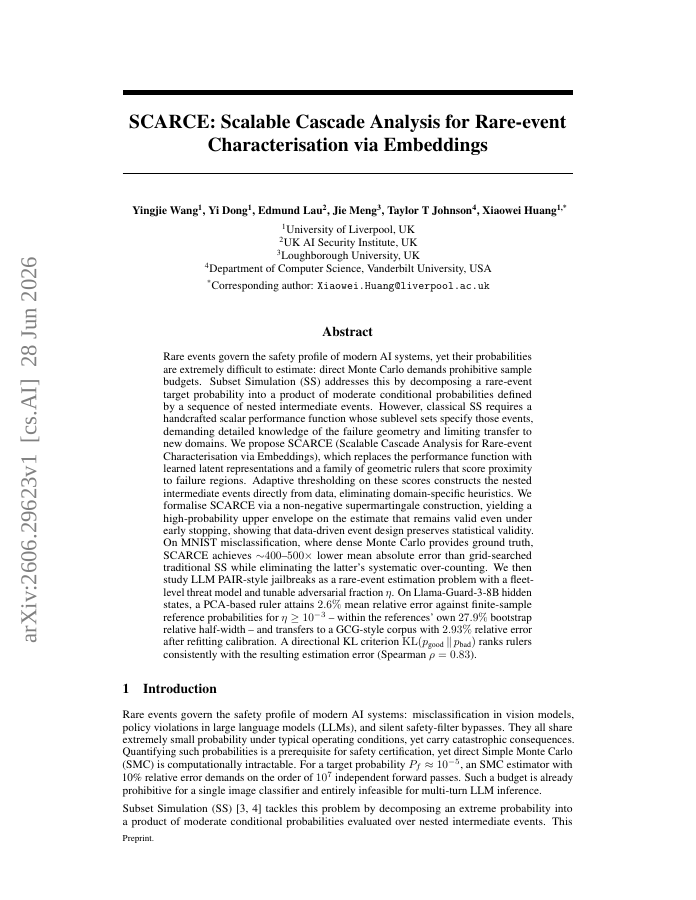
Rare events govern the safety profile of modern AI systems, yet their probabilities are extremely difficult to estimate: direct Monte Carlo requires prohibitive sample budgets. Subset Simulation (SS) addresses this by decomposing a rare-event probability into moderate conditional probabilities over nested intermediate events. However, classical SS requires a handcrafted scalar performance function whose sublevel sets define those events, demanding detailed knowledge of the failure geometry and limiting transfer to new domains. We propose SCARCE (Scalable Cascade Analysis for Rare-event Characterisation via Embeddings), which replaces the performance function with learned latent representations and geometric rulers that score proximity to failure regions. Adaptive thresholding constructs nested intermediate events directly from data. We formalise SCARCE through a non-negative supermartingale, yielding a high-probability upper envelope that remains valid under early stopping. On MNIST misclassification, where dense Monte Carlo provides ground truth, SCARCE achieves approximately 400--500 times lower mean absolute error than grid-searched traditional SS while eliminating systematic over-counting. We then study PAIR-style LLM jailbreaks under a fleet-level threat model with adversarial fraction η. On Llama-Guard-3-8B hidden states, a PCA-based ruler attains 2.6% mean relative error for η\geq 10^{-3} against finite-sample references whose average bootstrap relative half-width is 27.9%, and transfers to a GCG-style corpus with 2.93% relative error after recalibration. A directional criterion KL(p_{good},|,p_{bad}) ranks rulers consistently with estimation error (Spearman ρ=0.83).
SCARCE: Scalable Cascade Analysis for Rare-event Characterisation via Embeddings
Rare events govern the safety profile of modern AI systems, yet their probabilities are extremely difficult to estimate: direct Monte Carlo requires prohibitive sample budgets.
- Preview
- Year
- 2026
- Hosting
- Abstract onlyARXIV-DEFAULT
Cite
Notes
Only stored in your browser.
Attribution
- Abstract & full text
- arxiv.org/abs/2606.29623ARXIV-DEFAULT
- TL;DR
- Semantic Scholar