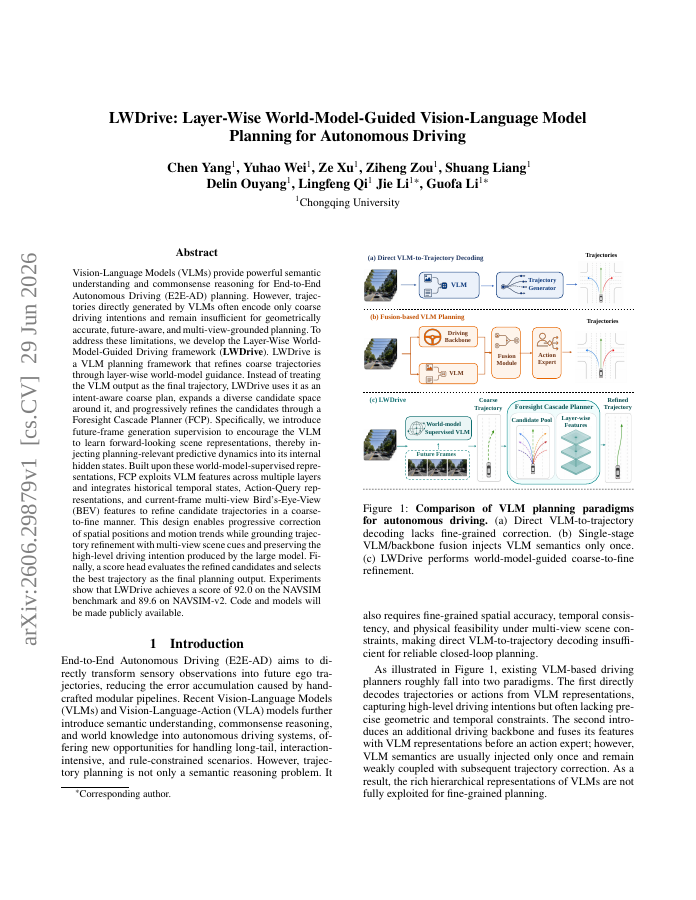
Vision-Language Models (VLMs) provide powerful semantic understanding and commonsense reasoning for End-to-End Autonomous Driving (E2E-AD) planning. However, trajectories directly generated by VLMs often encode only coarse driving intentions and remain insufficient for geometrically accurate, future-aware, and multi-view-grounded planning. To address these limitations, we develop the Layer-Wise World-Model-Guided Driving framework (LWDrive). LWDrive is a VLM planning framework that refines coarse trajectories through layer-wise world-model guidance. Instead of treating the VLM output as the final trajectory, LWDrive uses it as an intent-aware coarse plan, expands a diverse candidate space around it, and progressively refines the candidates through a Foresight Cascade Planner (FCP). Specifically, we introduce future-frame generation supervision to encourage the VLM to learn forward-looking scene representations, thereby injecting planning-relevant predictive dynamics into its internal hidden states. Built upon these world-model-supervised representations, FCP exploits VLM features across multiple layers and integrates historical temporal states, Action-Query representations, and current-frame multi-view Bird's-Eye-View (BEV) features to refine candidate trajectories in a coarse-to-fine manner. This design enables progressive correction of spatial positions and motion trends while grounding trajectory refinement with multi-view scene cues and preserving the high-level driving intention produced by the large model. Finally, a score head evaluates the refined candidates and selects the best trajectory as the final planning output. Experiments show that LWDrive achieves a score of 92.0 on the NAVSIM benchmark and 89.6 on NAVSIM-v2. Code and models will be made publicly available.
LWDrive: Layer-Wise World-Model-Guided Vision-Language Model Planning for Autonomous Driving
Vision-Language Models (VLMs) provide powerful semantic understanding and commonsense reasoning for End-to-End Autonomous Driving (E2E-AD) planning. However, trajectories directly generated by VLMs often encode only coarse driving intentions and remain insufficient for…
- Preview
- Year
- 2026
- Hosting
- Abstract onlyARXIV-DEFAULT
Cite
Notes
Only stored in your browser.
Attribution
- Abstract & full text
- arxiv.org/abs/2606.29879ARXIV-DEFAULT
- TL;DR
- Semantic Scholar