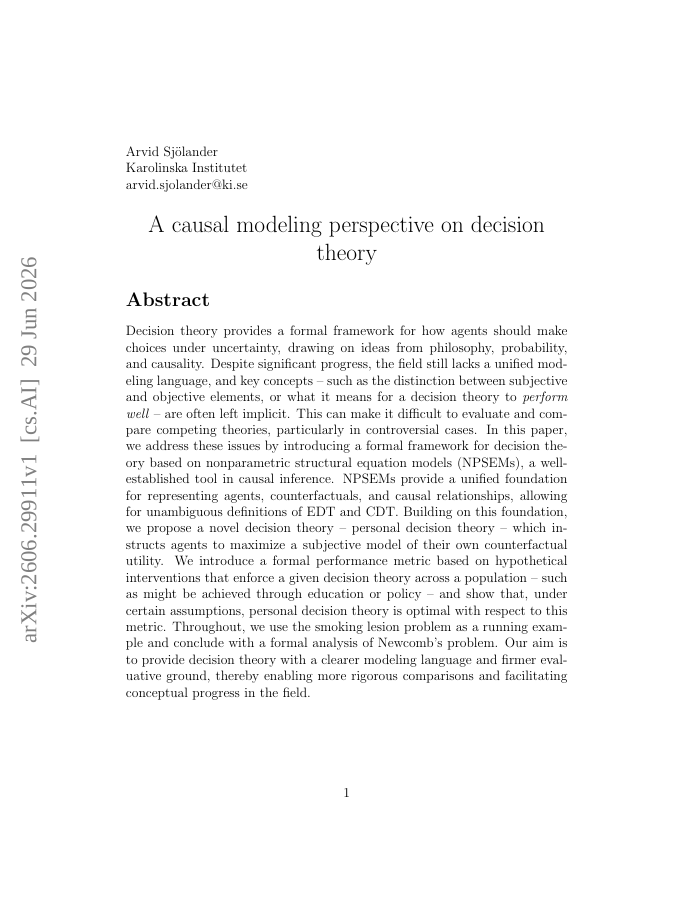
Decision theory provides a formal framework for how agents should make choices under uncertainty, drawing on ideas from philosophy, probability, and causality. Despite significant progress, the field still lacks a unified modeling language, and key concepts - such as the distinction between subjective and objective elements, or what it means for a decision theory to perform well - are often left implicit. This can make it difficult to evaluate and compare competing theories, particularly in controversial cases. In this paper, we address these issues by introducing a formal framework for decision theory based on nonparametric structural equation models (NPSEMs), a well-established tool in causal inference. NPSEMs provide a unified foundation for representing agents, counterfactuals, and causal relationships, allowing for unambiguous definitions of EDT and CDT. Building on this foundation, we propose a novel decision theory - personal decision theory - which instructs agents to maximize a subjective model of their own counterfactual utility. We introduce a formal performance metric based on hypothetical interventions that enforce a given decision theory across a population - such as might be achieved through education or policy -- and show that, under certain assumptions, personal decision theory is optimal with respect to this metric. Throughout, we use the smoking lesion problem as a running example and conclude with a formal analysis of Newcomb's problem. Our aim is to provide decision theory with a clearer modeling language and firmer evaluative ground, thereby enabling more rigorous comparisons and facilitating conceptual progress in the field.
A causal modeling perspective on decision theory
Decision theory provides a formal framework for how agents should make choices under uncertainty, drawing on ideas from philosophy, probability, and causality. Despite significant progress, the field still lacks a unified modeling language, and key concepts - such as the…
- Preview
- Year
- 2026
- Hosting
- Abstract onlyARXIV-DEFAULT
Cite
Notes
Only stored in your browser.
Attribution
- Abstract & full text
- arxiv.org/abs/2606.29911ARXIV-DEFAULT
- TL;DR
- Semantic Scholar